

Late August, a spider strolls across the living room floor like it pays rent. Then another the next night. The internet says they're fleeing the cold.
They mostly aren't. The wave is real; the reason isn't the one you've been sold, and that changes what works.

Why your house suddenly has spiders in September
Mating season. The spiders crossing your floor after dark are overwhelmingly mature males that left their webs to find females. The Burke Museum at the University of Washington: "What you are seeing is sexually mature males wandering in search of mates." They were already in the house, behind the dryer.
The number that reframes everything: "Generally fewer than 5% of the spiders you see indoors have ever been outdoors." Common house spiders are indoor-adapted; your basement is their native habitat, not a refuge from frost.
The honest counterweight: Colorado State University Extension says "some spiders wander indoors in the early fall when cooler outdoor temperatures force them to find shelter," with sac spiders the most common. So: mostly resident males on the move, plus a minority of true outdoor arrivals. The insects genuinely moving in from outside this month are the ones massing on the siding — the orange-and-black crowd on sunny walls.
Spiders are a symptom — they follow the insects
Spiders are predators. UC IPM calls them "mostly beneficial because they feed on pest insects," and states the chain most advice skips: "Outdoor lighting attracts insects, which in turn attracts spiders." Clemson agrees from the control side — "adequate insect control through proper sanitation, maintenance and insecticide use (if necessary) will help prevent spiders from becoming established" — adding that insecticide use should stay minimal.
Read that as a diagnosis: a steady spider population means a dependable insect supply. That's why the order of operations in handling household pests without hiring anyone starts with food and entry points, not a spray can. You're not fighting spiders — you're managing what they eat.
What actually reduces spiders indoors
No source quantifies how much any one fix cuts spider numbers, so treat these as extension best practice.
1. Vacuum the spider, web and egg sac in one pass. Clemson states that "spider webs, egg sacs, and individual spiders can be removed with a broom or vacuum." That dual payload — this generation and the next — is the best effort-to-result item here; UC IPM rates it "just as easy and much less toxic" than a pesticide. Limit: removes what's there, not what feeds them.
2. Close the gaps, starting at the door. Clemson specifies weatherstripping and a proper threshold with a door sweep; UC IPM adds sealing foundation cracks and gaps around windows and doors, plus checking screens. The same afternoon shuts mice out for pocket change. Limit: stops outdoor arrivals; residents are already inside.

3. Change the porch bulb. Clemson recommends swapping exterior white lights for a less attractive yellow or sodium vapor lamp; Colorado State says that "can limit spider web building." Limit: indirect and slow; any blog quoting a percentage of insects avoided is citing bulb sellers, not studies.
4. Clear the perimeter. Trimming plant growth away from the house "will discourage spiders from first taking up residence," says UC IPM, whose widow guidance adds moving woodpiles and ground-level debris off the foundation. Limit: changes where spiders settle, not how many live nearby.
5. Use sticky traps as monitors, not as the plan. UC IPM calls them "a noninsecticidal way to remove spiders" — provided they sit where pets and children can't reach. Colorado State suggests baseboards and migration routes. Limit: a trap shows the traffic; it won't clear a room.
The remedies that don't hold up
Conkers and peppermint: unproven at room scale, not disproven in a dish. A 2018 study in the Journal of Economic Entomology found that chestnuts and mint oil strongly repelled two of the three spider species tested in a two-choice assay. A real result — and a long way from your living room. Declining half a dish isn't staying out of a house, and none of the species tested was the common American house spider. Lemon oil, the most-recommended folk remedy online, had no effect on any of these spiders — the subject of the evidence review on essential oils.
Ultrasonic plug-ins. University of Arizona Cooperative Extension concluded that commercially available sonic pest devices for home use "have not been shown to be effective in scientific studies," so their use "is not advised." Note the shape of that claim: these are marketed at arthropods including spiders, but the trials reviewed ran on ants, cockroaches, bed bugs and mosquitoes. The spider claim was never tested at all.
Swallowing spiders in your sleep. The Burke Museum on the eight-a-year legend: "No such case is on formal record anywhere in scientific or medical literature."
The honest tier list
| Approach | Verdict | The limit |
|---|---|---|
| Vacuum spiders, webs, egg sacs | REAL | Returns unless prey and gaps are handled |
| Door sweep, weatherstripping, screens | REAL | Stops outdoor arrivals, not residents |
| Yellow or sodium-vapor exterior bulbs | REAL | Indirect; no measured spider number |
| Sticky traps along baseboards | REAL (monitor) | Keep clear of pets and children |
| Peppermint oil, conkers | MYTH at room scale | Shown in a dish, never in a house |
| Lemon oil | MYTH | Failed on every species tested |
| Ultrasonic plug-ins | MYTH | Advised against; never tested on spiders |
| Total-release foggers | DANGEROUS | Flammable, inhalation risk, little effect |
The two spiders worth learning to recognize
Nearly all spiders are venomous; only two US groups carry real medical significance — and habitat identifies both better than markings.
Widows
UC IPM describes the mature female as "shiny jet black all over her body and legs, except for a red pattern on the underside of the abdomen," at about 1/2 inch (13 mm). Males and immatures look nothing like that — striped abdomens, tan legs — so "small striped spider" is not a widow. Habitat is the better tell: crevices, garages near doors and vents, the sheltered lips of patio furniture, usually within about three feet of the ground. Hence UC IPM's advice: gloves when reaching into stored boxes or moving firewood.
Recluses
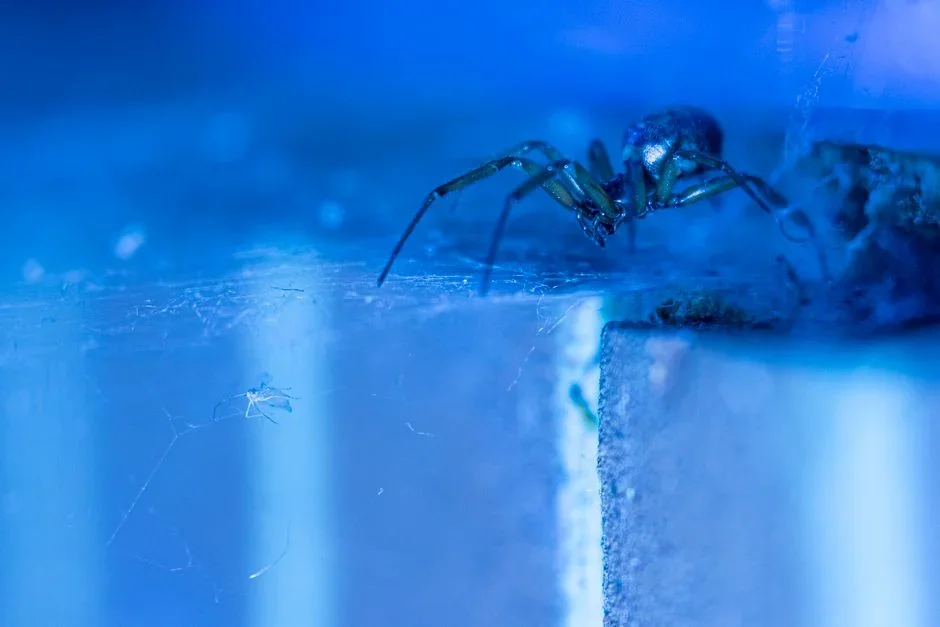
Skip the violin. UC IPM says the definitive feature is "6 equal-sized eyes arranged in 3 pairs," while the violin marking is not a reliable way to identify this spider; legs are uniformly colored, body no more than 3/8 inch. Penn State puts the body at about 9 millimeters. Photograph it from a safe distance — never handle or lean over a suspected widow or recluse to count eyes.
The brown recluse lives in far fewer places than you think
Penn State Extension lists established populations in sixteen states: Alabama, Arkansas, Georgia, Illinois, Indiana, Iowa, Kansas, Kentucky, Louisiana, Mississippi, Missouri, Nebraska, Ohio, Oklahoma, Tennessee and Texas — elsewhere, only isolated occurrences. UC IPM is blunter: "There are no populations of the brown recluse spider in California."
A 2005 survey in the Journal of Medical Entomology examined 1,773 arachnids from 49 states submitted as suspected recluses. From 25 of 29 states completely or almost completely outside the range of Loxosceles, no recluse spiders were submitted at all.
That matters medically. Penn State notes most claimed bites are misdiagnoses of other issues, including poison ivy, chemical burns, and diabetic ulcers. UC IPM reports one toxicology physician's estimate that 60% of such diagnoses came from areas with no known Loxosceles — an estimate, not a statistic, but sobering when the real cause is a MRSA or strep infection.
If you're actually bitten
UC IPM says about 10% of brown recluse bites cause moderate or greater tissue damage; most cause inflammation that heals without intervention, and deaths are extremely rare. A widow bite starts nearly painless; Poison Control describes "cramping and muscle twitching near the bite site which progresses to the chest, back, or abdomen." Symptoms usually dissipate in a few days, and antivenom is available.
Wash with soap and water, put cold water or a cloth filled with ice on the bite for 10 to 20 minutes, and call Poison Control at 1-800-222-1222 or use webPOISONCONTROL — free, confidential, and available 24 hours a day. Outside the US, use your national poison center. Get emergency care for trouble breathing, chest pain, severe or spreading pain, or a worsening wound — and call promptly for a young child, older adult, or anyone pregnant. Poison Control also notes a recluse bite is very difficult to diagnose unless the victim felt it and correctly identified the culprit — infections and circulation problems mimic it.
The overreaction that costs more than the spiders
Every fall, somebody answers three spiders with a fogger. Colorado State's verdict is specific to this target: "Total release foggers, containing pyrethrins, probably will have little effect on spiders." UC ANR supplies the mechanism — foggers are "rarely effective for control of crawling insects" that hide in crevices and escape direct exposure. A spider that never crosses a treated surface is never treated.

The risk isn't theoretical. The EPA warns that "because the aerosol propellants in these foggers typically are flammable, improper use may cause a fire or explosion," that "breathing spray mist may be harmful," and that reentering without airing out may cause illness. UC ANR names the trigger: explosions can occur if pilot lights are not extinguished first. Children, pets and anyone with asthma absorb that risk for no benefit. Sprays are no shortcut either — UC IPM says insecticides will not provide long-term control without the housekeeping. If the problem outruns a vacuum and a caulk gun, hire a licensed pest professional.
Common mistakes
- Sealing against an invasion that isn't happening. Weatherstripping is worth doing, but most of what you're seeing was already indoors. Vacuum first, and save the caulk gun for the insects that really do come in from outdoors — stink bugs gather on sunny walls before the first cold snap.
- Spraying the baseboards and calling it done. Colorado State: "Pesticides alone, without some effort to remove or modify favorable spider habitats, will not be effective."
- Calling a necrotic wound a spider bite. Outside the sixteen-state range especially, that delays treatment for an infection that worsens meanwhile.
FAQ
Should I kill house spiders or put them outside?
Either is fine for you; neither helps an indoor-adapted spider, since outdoors isn't where it lives. UC IPM notes spiders eat a large number and variety of nuisance and pest insects, so one in a basement corner is doing unpaid work.
Do spiders bite people in their sleep?
Vanishingly unlikely. UC IPM notes that the jaws of most spiders are so small that the fangs cannot penetrate the skin of an adult person, and most suspected bites turn out to be something else.
What about sac spiders, the real fall wanderers?
Colorado State flags them as the most common spider wandering homes in fall, particularly at night — while adding the bite, though painful, usually causes no other symptoms and the pain subsides after a few minutes. Shake out clothes stored in garages.
The takeaway: The fall spider wave is mating season rather than an invasion, and a vacuum, a door sweep and a different porch bulb will do more than anything in a spray can. Spend less. Live more. — The Thrifty Almanac






0comments