


You have seen the video. Somebody pulls a refrigerator from the wall, holds up a brush caked in gray fuzz, and promises ten minutes of vacuuming will cut your power bill thirty percent. The number never has a source attached.
Five fridge beliefs circulate constantly: clean the coils, crank it colder, replace the gasket, unplug it overnight, keep a spare in the garage. Graded below as REAL, MYTH, or DANGEROUS — one is worth your Saturday, two are maintenance wrapped in a fake savings figure, and one can quietly make your family sick.
First, the number that ends the argument
Refrigerators account for about 7% of the electricity used in US homes, per the Energy Information Administration. If your fridge vanished entirely, your bill would fall by roughly 7%. A ritual that improves a fraction of that appliance's efficiency cannot cut the whole bill 30%. The arithmetic retires the claim without any contested study.
The rest of the bill lives elsewhere. In EIA's 2020 data the largest end uses were air conditioning at 19%, space heating at 12%, water heating at 12% — each bigger than refrigeration, and where a real bill cut has to come from, as our roundup of no-cost habit swaps that trim power use covers.
| Home electricity end use | Share of consumption |
|---|---|
| Air conditioning | 19% (2020) |
| Space heating | 12% (2020) |
| Water heating | 12% (2020) |
| All refrigeration | ~7% (2015 survey) |
In dollars, EIA put the primary fridge at about $87 a year in 2020, a second unit at $61. Rates have risen since, so treat those as floors — the same lesson as the panic over smart meters inflating bills.

VERDICT — Coil cleaning: real maintenance, invented savings number
Grade: mostly myth. ENERGY STAR does recommend it, but read the scope: "keep the condenser coils clean if you have an older model", and read your manual first for safe cleaning. No savings percentage is attached.
How: unplug the fridge at the wall first, find the coils — a black grille at the back or behind a kick-panel underneath — and brush and vacuum the dust off. Coil brushes cost a few dollars at hardware stores.
Why: coils shed the heat pulled from your food, and dust is insulation. Virginia Tech Extension adds the step most skip — "leave a space between the wall or cabinets and the refrigerator or freezer, and keep the coils clean".
The limit: no agency or university publishes a measured savings figure for this task, in either direction. So we print no number, and do not claim the savings are near zero either. Any percentage attached to this chore online is unsourced.
VERDICT — Temperature: REAL, but colder is not better
Grade: real, and the best free move here. Two numbers circulate because they answer different questions. Food safety sets a ceiling: UC's Master Food Preserver program states "the refrigerator should be at 40°F or below", freezer at 0°F, matching FDA and USDA guidance. ENERGY STAR gives an efficiency target of 35 to 38 degrees Fahrenheit, and Illinois Extension puts the band at "between 34° and 40°F", where most bacteria grow extremely slowly if at all. So the honest answer is roughly 35–40°F; colder buys no extra safety, only cost. Cornell Cooperative Extension: "You're losing money if they're lower than 37-40°F for fresh food and 0-5°F in your freezer."
How to check: the dial marked 1 through 7 is not degrees. Cornell's method: one thermometer in a glass of water in the center of the fridge, another between packages in the freezer, read after 24 hours. The water glass evens out door-opening swings.
The limit: no verified source quantifies the cost per degree, so the penalty is real but unmeasured. Never run above 40°F to chase efficiency.
VERDICT — Door gaskets: real when they're actually failing
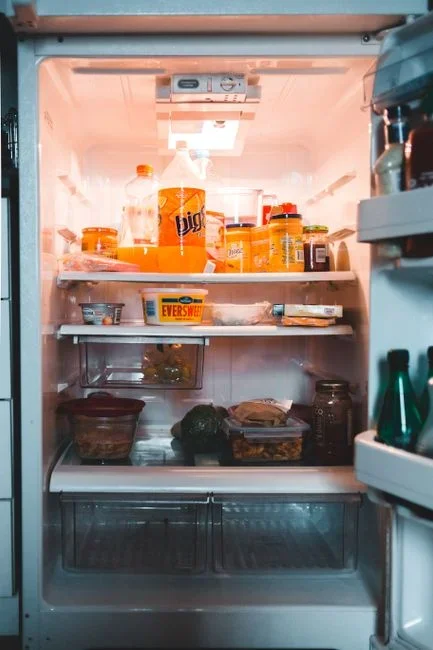
Grade: conditionally real. ENERGY STAR's instruction is one sentence: "Make sure the seals around the door are airtight. If not, replace them." That is fault repair, not a routine chore. Real failure looks like cracks or tears, gaps you can see daylight through, condensation along the seal line, or a door that no longer pulls itself closed.
The limit: the popular dollar-bill test appears in no government or extension publication we could verify — an informal screen, not an official diagnostic. And no verified figure exists for gasket energy loss, so we print none.

The one that actually costs you: the second fridge in the garage
The real money is a decision, not a chore. EIA's 2020 survey counts 42.53 million US homes running a second refrigerator — 16.25 million in the garage, 9.68 million in the basement, and the share with more than one grew from 30% in 2015 to 34% in 2020. Those spares skew old: 9.72 million are 15 or more years old, against 14.31 million of 122.86 million kitchen units.
| Refrigerator age (2020) | Second fridges | Most-used fridges |
|---|---|---|
| All units in service | 42.53 million | 122.86 million |
| 15–19 years | 5.13 million | 8.82 million |
| 20+ years | 4.59 million | 5.49 million |
| Share 15 years or older | ~23% | ~12% |
ENERGY STAR's Flip Your Fridge factsheet says "by keeping a second refrigerator in your basement or garage, you could be wasting $80 per year". Cornell Extension is blunter: "Got a second older refrigerator? Unplug it! Remember: it can cost about $140 a year to keep it plugged in." And 17% of these homes used the spare six months or less — millions running year-round for a holiday and two barbecues.
The garage matters physically, too: the Department of Energy rates refrigerator energy use at a 90°F ambient condenser-inlet temperature — the condition the yellow EnergyGuide number assumes, and one an uninsulated garage in July can exceed.
Fair caveat: the survey reports age and location separately, so we cannot say garage units specifically are oldest. Nor is this the priciest appliance in your house — air conditioning outweighs all refrigeration nearly three to one. Just the most pointless line on your bill. If the spare mostly handles party overflow, our guide to holding food cold without a second appliance has cheaper options.

MYTH — Unplugging overnight (but do unplug the spare)
Your kitchen fridge: myth, and a food-safety loss. Michigan State University Extension gives three outage thresholds: four hours of safe cold with the doors closed; keep food only if still 40°F or lower; discard after two hours above 40°F. An eight-hour unplug breaks all three — and at about $87 a year, or roughly 24 cents a day, it saves a handful of cents.
An unused spare: real, and recommended. Empty it, defrost it, pull the plug — the largest refrigeration saving most households can make. If it stays put, prop the door open so it does not grow mold. If you are storing or discarding it, the Consumer Product Safety Commission is emphatic: childproof appliances "to be discarded or are in storage," and "the surest method is to take off the door completely". Children have suffocated inside abandoned units.
DANGEROUS — where saving watts becomes a health risk
Never run above 40°F to save power. Bacteria grow most rapidly between 40°F and 140°F, doubling in as little as 20 minutes; refrigerate perishable food within 2 hours, or 1 hour when the air is above 90°F.
Do not treat a garage, porch, or unheated mudroom as cold storage. Penn State Extension is explicit that in those spaces "the temperature can fluctuate above and below 40°F day-to-day or overnight", and recommends limiting such storage to drinks that need no refrigeration. Wildlife and pets are the second hazard.
Do not lean on an aging garage unit in a heat wave. Given that 90°F test basis, a marginal compressor in a hot garage can drift above 40°F for days with nobody opening the door to notice. Put an appliance thermometer in any garage unit — mandatory if you keep meat there. Once food has been above 40°F more than two hours, discard it rather than judging by smell — and if anyone in the house is pregnant, elderly, very young, or immune-compromised, throw it out without debating. For suspected food poisoning, call your doctor or Poison Control at 1-800-222-1222.
The honest tier list
| Claim | Verdict | Effort & cost | Realistic payoff |
|---|---|---|---|
| Vacuum the condenser coils | Mostly myth | 30 min, a brush | Unquantified; upkeep on older units only |
| Set the right temperature | REAL — best free move | 5 min, a thermometer | Stops paying to over-cool |
| Replace the door gasket | Real only if failing | Inspection free | Fixes a fault; not routine |
| Unplug the main fridge overnight | MYTH — and unsafe | — | Pennies, against a 4-hour safety window |
| Retire the unused garage fridge | REAL — the big one | One afternoon | ~$80/yr wasted; ~$140/yr if old |
In that order: measure the temperature this week, decide the spare's fate this month, check the gasket, and clean the coils only if the fridge is old. Shopping instead? ENERGY STAR models are about 9 percent more efficient than the federal minimum, and top-freezer layouts run under $45 a year. More in our library of household money-savers.
Common mistakes
- Chasing a 30% bill cut from an appliance that is 7% of the bill.
- Trusting the 1-to-7 dial instead of a thermometer.
- Running it as cold as it goes, which adds no safety below the 35 to 38°F band.
- Cleaning coils while a 20-year-old spare holds six cans in the garage.
- Treating a cold porch as a refrigerator, when temperatures swing past 40°F overnight.
- Leaving a retired fridge with its door attached — CPSC says take it off.
FAQ
How much does cleaning refrigerator coils actually save?
Nobody authoritative publishes a figure. ENERGY STAR recommends it for older models without attaching a percentage. Any number circulating online is unsourced.
What temperature should my refrigerator be set to?
Roughly 35–40°F. ENERGY STAR targets 35 to 38°F; food-safety guidance sets 40°F as the ceiling and 0°F for the freezer. Verify with a thermometer, not the dial.
Is a second refrigerator in the garage worth keeping?
Only if it is reasonably new and used year-round. ENERGY STAR estimates a spare wastes around $80 a year; Cornell puts an old one near $140.
Can I unplug my fridge overnight to save electricity?
No. A closed refrigerator holds safe temperatures about four hours, and food above 40°F for more than two hours should be discarded. The saving is a few cents; the risk is your groceries.
The takeaway: Set the fridge near 37°F, clean the coils only if it is old, then go unplug the spare in the garage — that last one beats every coil video combined. Spend less. Live more. — The Thrifty Almanac




0comments