

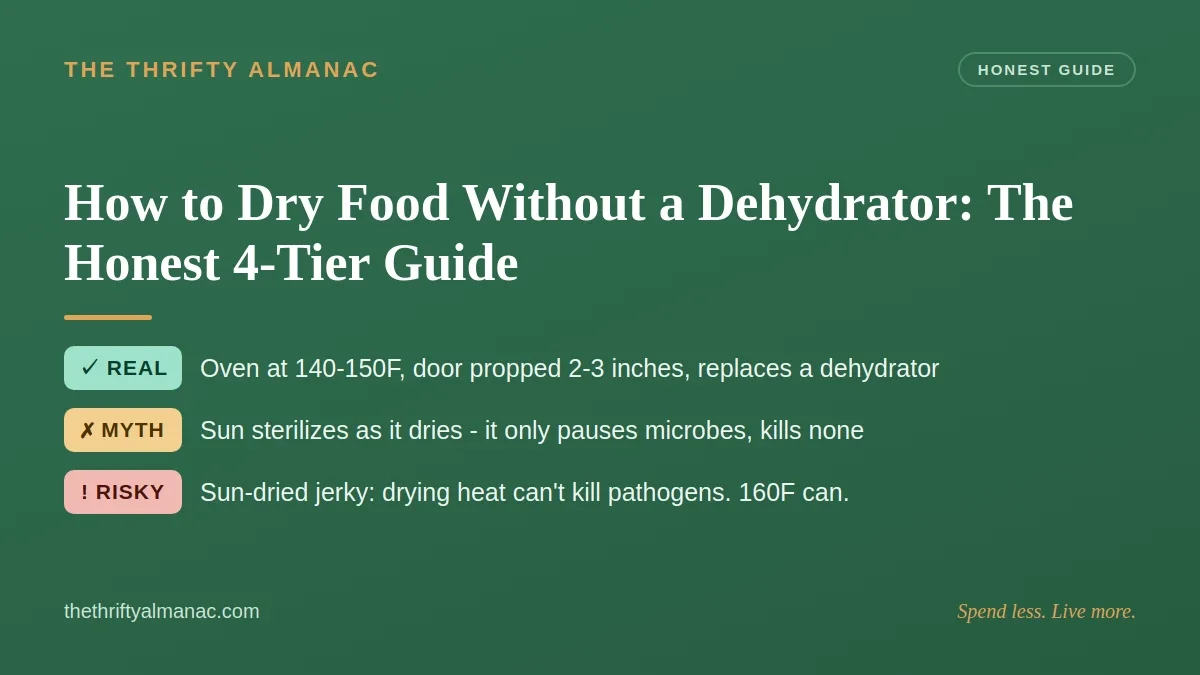
A flat of peaches on the counter, a garden that quit being polite in August, and no dehydrator. The trend videos promise twenty foods the Amish dried without electricity — the techniques are real, the attribution is folklore. None of them mention the step that decides whether your jar holds food in six months or a science project.
Here is the honest ranking, drawn from US extension food-preservation guidance. Your humidity picks the method, not your enthusiasm.
The short version: four no-dehydrator methods, ranked
| Verdict | Method | What it dries | Conditions | Extra step |
|---|---|---|---|---|
| REAL | Air-drying herbs | Leafy herbs only | Warm, dry, dark room | None |
| REAL | Vine drying | Shelling beans, lentils | Pods on the plant until beans rattle | Pasteurize |
| REAL | Oven, door propped | Fruit, vegetables, leather | An oven holding 140–150°F | None |
| CLIMATE-GATED | Open sun or a built solar dryer | Fruit only | 85°F+, humidity under 60% | Pasteurize |
| MYTH | "Sun sterilizes as it dries" | Believe it, skip a step | No weather makes it true | Drying kills nothing |
| DANGEROUS | Meat outdoors, vegetables in sun, car dashboards | Nothing safely | No safe home version | Use controlled heat |
Read that fourth row twice before buying screens. Penn State says Pennsylvania's humidity makes sun drying impractical, Clemson says the weather rarely cooperates in South Carolina when fruit ripens, and Ohio State rules it out for Ohio. Most readers land in the oven tier — one more entry in our practical home fixes.
Why drying preserves food — and the one thing it does not do
From New Mexico State: drying removes moisture, and moisture is necessary for the bacterial growth that causes spoilage. Ohio State puts a number on it — properly dried vegetables hold about 10 percent moisture, and no known microorganisms grow at that level. NCHFP sets fruit near 20 percent.
Drying puts microbes to sleep. It does not kill them. That explains every rule below: why raw meat needs heat, why outdoor-dried fruit needs pasteurizing, why a moldy jar gets tossed. Shelf-stable and immortal are different words — see the short list of foods that genuinely keep forever.
Tier REAL: herbs, and the paper-bag trick that stops mold
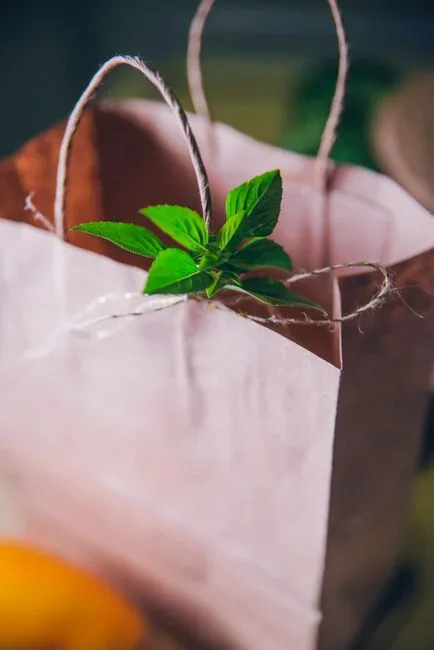
This needs nothing and works in any climate. NCHFP splits herbs in two. Sturdy ones — rosemary, sage, thyme, summer savory, parsley — tie in small bundles and hang. Tender-leaf ones — basil, oregano, tarragon, lemon balm, mints — hold enough moisture to mold unless they dry fast, so hang those inside paper bags with holes torn in the sides.
They're done when they crumble and stems break when bent. Dried herbs run 3 to 4 times stronger than fresh, so use a quarter to a third of what a recipe lists. Limit: herbs only — fruit and vegetables hung indoors spoil before they dry.
Tier REAL: beans that dry themselves on the vine
Vine drying is the zero-input method, and NCHFP's one exception to "no vegetables outdoors." Navy, kidney, butter, great northern and lima beans, plus lentils and soybeans: leave the pods on the vine until the beans rattle inside, then pick and shell. No pretreatment needed; beans still moist aren't finished and can finish in sun, oven or dehydrator.
Limit: shelling beans left on the plant, not green beans picked and laid on a tray. Having dried outdoors, they need pasteurizing.
Tier REAL: your oven is the dehydrator substitute
Set the lowest temperature your oven holds. Penn State: 140–150°F, door open 2 to 3 inches. Clemson: check the dial reaches 140°F, door propped 2 to 6 inches. NMSU: not below 140–150°F, door open at least an inch. That propped door is how moisture escapes, so it isn't optional.
Clemson says oven drying takes twice as long as a dehydrator and uses more energy; Utah State says two to three times longer. The oven is the no-purchase option, not the cheap one. The one sourced duration is fruit leather: 6 to 8 hours in a dehydrator, up to 18 in an oven.
Don't crank it. Too much heat causes what Penn State calls case hardening — the surface hardens and traps moisture in the center of the slice. It looks done on the tray; it molds in the jar. Limit: if your oven's lowest setting sits above 150°F you're baking, and no extension source publishes per-food oven times, so test the food, not the clock.
Tier CLIMATE-GATED: sun drying, fruit only, weather permitting
Answer this first: can you count on 85°F or hotter with humidity under 60 percent for several breezy days running? Utah State sets a stricter bar — a rainless season and temperatures above 98°F. The honest read: 85°F is the floor, near-100°F actually finishes fruit before it spoils.
Fruit only. NCHFP says the sugar and acid content of fruits makes them safe outdoors when conditions are favorable; vegetables and meats are not. Cover the trays at night, since cool night air condenses and adds moisture back. For screening, NCHFP approves stainless steel, Teflon-coated fiberglass and plastic, warning off galvanized hardware cloth, copper (destroys vitamin C) and aluminum.
A built solar dryer is the upgrade — an enclosure that traps heat, moves air and shuts out insects — and Utah State says plans are available from county Extension offices. Dashboard drying is endorsed by no .gov or .edu source we could reach, and the dramatic claims against it trace to commercial pages, not agencies. Limit: fail the humidity test and fruit molds before it dries, so for much of the country this tier stays theory.
Tier DANGEROUS: what actually puts people in the hospital
Raw meat and poultry. Ohio State is blunt: dehydrator and oven drying temperatures are not high enough to destroy harmful microorganisms typically present in raw meat, so strips must reach an internal 160°F, or 165°F for poultry. USDA's recommendation, relayed by Penn State: heat meat to 160°F before dehydrating, then hold 140°F through drying. Ohio State's post-drying alternative uses a 275°F oven, and sun drying isn't recommended for jerky. Heat makes jerky safe; drying only makes it shelf-stable.
Dried tomatoes in oil. Extension specialists warn that olive oil is an anaerobic environment where Clostridium botulinum spores can turn into toxin. Skinned halves with no acidification step belong in the refrigerator, used within 4 days — not in a jar on the counter. The same spore is the reason low-acid jars need a pressure canner instead of a boiling-water bath. Clemson lists blurred or double vision, weakness and difficulty swallowing as symptoms, usually within a day of the meal, and says hospital care is necessary. Suspected botulism is an emergency room, not a search engine.
The three steps everyone skips
1. Test dryness once the food cools. Colorado State's squeeze test: grab a handful — if no moisture is left on your hand and the pieces spring apart, they're dry. Penn State adds that fruit is done when pliable with no beads of moisture when pressed, vegetables when tough or brittle; NMSU says cooled jerky cracks but doesn't break.
2. Condition for 7 to 10 days. The highest-value step here, and the one the viral videos never cover. NCHFP: pack loosely in plastic or glass jars, seal, let stand 7 to 10 days, shaking daily so moisture redistributes between wetter and drier pieces. Colorado State says four to 10 days, NMSU about a week. Condensation inside the glass sends it back to dry more.
3. Pasteurize anything dried outdoors, because insects and their eggs come with the territory. Two accepted methods, per NCHFP and Clemson: a single layer in a shallow pan in a 160°F oven for 30 minutes, or sealed in freezer bags at 0°F or below for at least 48 hours. NMSU lists 150°F; use the higher one. The freezer route is free if you already run one — the logic behind these freezer habits that stretch food further.
Pretreating fruit — worth it, but skip the sulfites
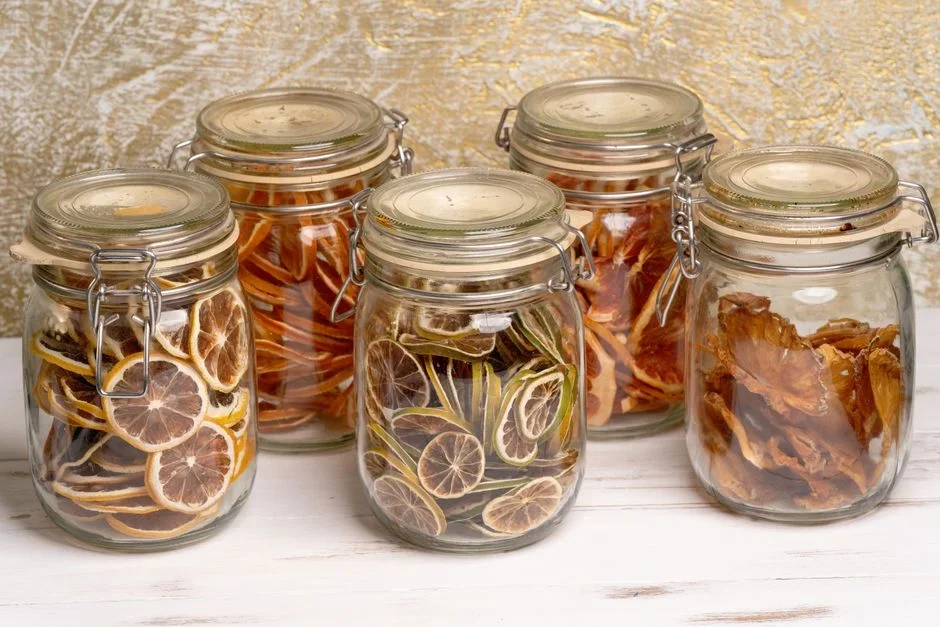
Utah State's dips use cupboard staples. Apples: 2½ teaspoons of crystalline ascorbic acid per cup of cold water. Peaches, apricots and pears: 1 teaspoon per cup. No crystals? Crush vitamin C tablets, 1 teaspoon of 500 mg tablets per quart. For vegetables, blanching stops the enzyme action that controls color and flavor and cuts drying time — steam rather than scald, since water-soluble nutrients are lost in the blanching water.
Sulfite dips appear in older extension guides, and we're deliberately not leading with them. The regulatory record: in 1986, after numerous cases of sulfite-induced asthma, FDA prohibited sulfites on produce meant to be served raw; they must be declared at 10 ppm total SO2 or more, including in dried fruit pieces; and FDA is aware of deaths among sulfite-sensitive asthmatics. If anyone eating your fruit has asthma, that decides it.
Storage, shelf life, and when to throw it out
| Food | Stored cool, dry and dark | Source |
|---|---|---|
| Dried fruit at 60°F | Up to 1 year | NCHFP |
| Dried fruit at 80°F | About 6 months | |
| Dried vegetables | Half the shelf life of fruit | |
| Fruit leather | 1 month at room temperature, 1 year frozen | NCHFP |
Those are quality guidance, not tested expiry dates, and they assume the food hit its moisture target and was conditioned; Colorado State gives a general 6 to 12 months.
You may have heard the one-inch rule. It's real, and it won't rescue your apricots. NC State Extension allows cutting at least 1 inch around and below a mold spot on firm produce and hard cheese, but says pitch soft, high-moisture foods. Root threads run deep and may spread toxins through the food, and mycotoxins are heat stable, so cooking doesn't help — USDA's National Agricultural Library ties aflatoxins to improperly stored food. Dried food with mold gets discarded.
Common mistakes
- Assuming hot means dry. Humid air molds fruit before it dries.
- Believing sunlight sterilizes. Outdoor-dried food still needs the 160°F oven or 0°F freezer step.
- Turning the oven up to finish faster. That's case hardening: dry shell, wet center.
- Skipping conditioning. The step that decides whether the jar survives month six.
- Cutting mold off dried fruit. Discard it — heat won't fix the toxins.
FAQ
Is conditioning really necessary?
Necessary. Pieces from one tray finish at different moisture levels, and a sealed jar shaken daily for 7 to 10 days equalizes them. Condensation on the glass warns you it isn't dry enough to store.
Can I sun-dry tomatoes?
Tomatoes are an acid fruit, so they clear the fruit-only rule — but only if your weather holds 85°F with humidity under 60 percent for days running. Fail that and you get mold. Never store them in oil at room temperature.
What about chile ristras?
Genuine, but climate- and variety-dependent. NMSU notes green chile is not acceptable for ristras, since it only shrivels and turns dull orange, and that modern thick-walled cultivars may deteriorate rather than dry — hence 'New Mexico 6-4' and 'Sandia'.
The takeaway: Herbs and beans dry almost anywhere, your oven with the door propped does the rest, and anything dried outdoors earns its jar only after 30 minutes at 160°F. Spend less. Live more. — The Thrifty Almanac



0comments