

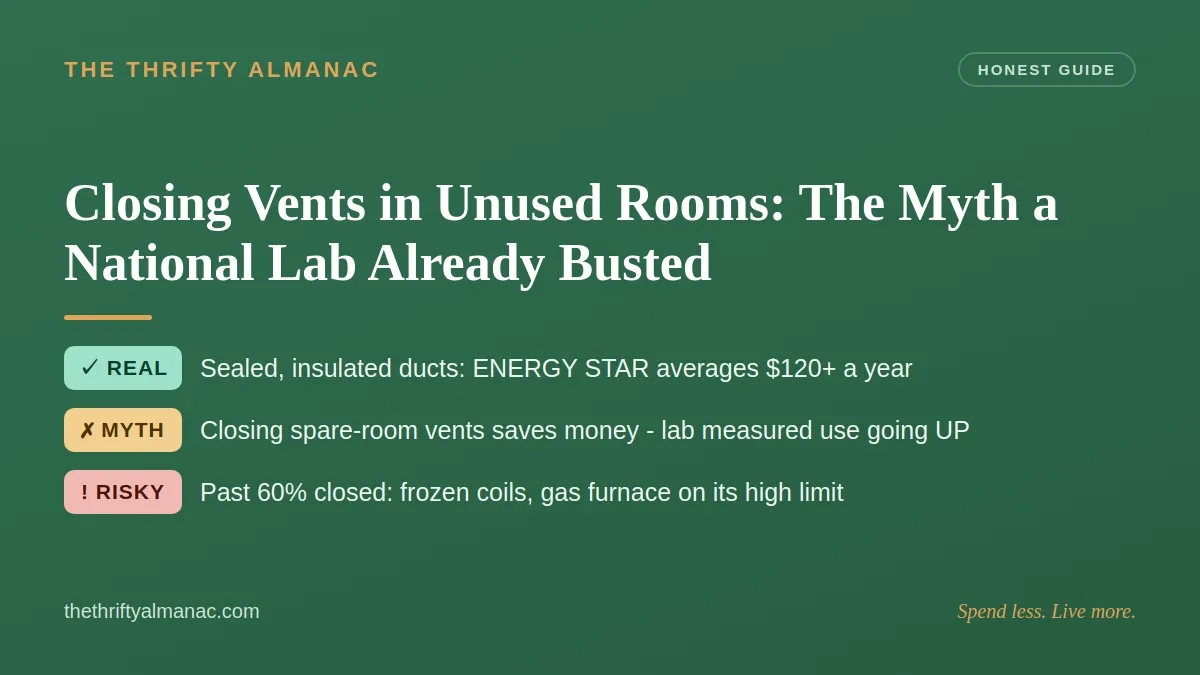
The clip is always the same: a hand flips the lever on a spare-bedroom floor register, the vent snaps shut, and the caption promises a smaller bill. Fewer rooms to condition, less work, less money gone.
It is also one of the few home myths a national laboratory already tested. Closing registers does not turn your furnace down — it strangles it, and much of the air you thought you saved ends up heating your attic.
The lab report that already settled it
In 2003, Iain S. Walker at Lawrence Berkeley National Laboratory published LBNL-54005, Register Closing Effects on Forced Air Heating System Performance. It used a purpose-built ten-register duct system in a crawlspace, closing registers one at a time while measuring pressure, airflow, leakage and blower power, then ran those results through simulations of a California reference house in three climate zones.
The finding: "register closing led to increased energy use", because shrinking the conditioned area was "offset by increased duct system losses; mostly due to increased duct leakage." Scope, stated once: one lab duct system plus simulations of California houses whose ducts run outside the conditioned space — attics and crawlspaces, not inside the insulated envelope. That becomes the one honest exception below.
The honest tier list
| The move | Verdict | What the public record says |
|---|---|---|
| Closing registers to cut the bill | MYTH | Simulated energy use rose in every case, by up to 39% |
| Closing more than 60% of registers | DANGEROUS | LBNL: "not recommended" — high-limit operation, frozen coils |
| Closing the register farthest from the air handler | REAL, narrowly | Far registers affect only their own branch |
| Sealing and insulating reachable ducts | REAL | ENERGY STAR average: $120 or more a year |
Why blocking a vent doesn't turn the blower down
Pinching a garden hose does not turn off the tap. A blower is the same: sized for a fixed duct system, it pushes against whatever resistance it finds. LBNL measured the result — across the whole closing sequence, blower draw fell only from about 570 W to 460 W on a system being progressively choked. As flow drops, pressure across the air handler rises, so power stays nearly constant.
That pressure goes somewhere. With four registers closed, average register-boot pressure ran 3 to 4 times higher when the registers nearest the plenum were shut first, roughly doubling system leakage.
Where the "saved" air goes: your attic and crawlspace
ENERGY STAR reports that in a typical house about 20 to 30 percent of the air moving through the ducts is already lost to leaks and bad connections — a share of the ductwork's air, not of your whole bill, but air you paid to condition.
Raise the pressure and those leaks grow. On the lab rig, supply-boot leakage climbed from 5% to 55% of air handler flow, and plenum leakage rose about 3.5 times. In the simulations, 3 of 10 registers closed raised modeled gas use 5% to 39% and air handler electricity 7% to 39% — California reference houses, not your address, but the direction never reversed.
Leaks run both ways: ENERGY STAR notes leaky attic and crawl space ducts let in dirt, dust, moisture, pollen, pests and fumes. The instinct behind cheap weatherstripping at windows and doors pays better here.
Cooling season: the frozen coil
An air conditioner cools by moving house air across a cold evaporator coil, and that moving air keeps the coil from getting too cold. Cut the airflow and the coil does not cool the house harder — it cools itself, until condensing moisture freezes instead of draining: ice on the line, warm air at the registers, a puddle when it thaws.
LBNL gives two real thresholds. A guardrail: a reduction in air handler flow of about 20% is the stated maximum acceptable, reached at six of ten closed on the tight test system. A hard stop: closing more than 60% of registers is "not recommended," since restriction reaches the point where "cooling systems may suffer from frozen coils." That is a risk named in the report's conclusions, not a freeze the study measured — and it beats the popular "a quarter of your vents" line, which has no authoritative source behind it.
Closed registers are one of several airflow crimes: DOE's Building America guide lists dirty filters and coils as raising static pressure the same way. If everything is open and the coil still ices, check the filter.

Heating season: the high-limit switch, and the real hazard
Gas furnaces only: heat pumps and electric furnaces carry the airflow penalties, not the combustion hazard.
Three documented links, kept separate. One: LBNL states that severe restriction pushes systems to where "furnaces may operate on the high-limit switch" — a safety device that shuts the burner down when the heat exchanger area overheats, which DOE's weatherization procedure has technicians verify is set no higher than 200ºF. Two: a municipal fire department's gas heating page lists poor airflow to the furnace among the causes of heat exchanger damage, whose main hazard is carbon monoxide release into the home. Three: CDC reports more than 400 Americans die each year from unintentional CO poisoning not linked to fires, with symptoms often mistaken for flu — headache, dizziness, weakness, upset stomach, chest pain and confusion. CPSC counts more than 200 deaths a year tied to consumer products, heating equipment among the top.
Three facts, not one chain: no study has measured how often closing registers ends in a cracked heat exchanger, so do not read a straight line from shut vent to poisoning. Keep the airflow, book the yearly inspection both agencies recommend, and install CO alarms near every sleeping area, replaced per the manufacturer or every 5 years. Inspecting a heat exchanger is a licensed technician's job. If a gas furnace short-cycles, smells wrong, or an alarm sounds, get out and call for help.
The quiet one: humidity in a sealed-off room
Air conditioning does two jobs. Cooling is the one you notice; pulling moisture out of the air is the one you don't. Shut a room's supply and close its door in a humid July and you have not saved that room — you have removed its dehumidification.
EPA sets the bar: keep indoor relative humidity below 60 percent, ideally 30 to 50 percent, and treat condensation on windows, walls or pipes as a sign of high humidity. Its mold course gives the mechanism: warm, humid air contacting a cold surface can form condensation, and mold grows on virtually any organic material once moisture is present — though material dried within 24 to 48 hours usually stays clear. Closed rooms do not automatically grow mold; those conditions just get likelier with nobody there to notice. EPA names the cheap diagnostic — a humidity meter runs $10 to $50. Above 60 percent in that room, reopen the register.

What actually works, ranked cheapest first
- Seal and insulate reachable ducts. DIY, best return per dollar. Mastic sealant or metal tape — ENERGY STAR says never duct tape. ENERGY STAR's average for sealed, insulated ducts is $120 or more a year; sealing plus insulating averages up to 10% of annual energy bills. Averages, not promises, and only the ducts you can safely reach.
- Fix return-air starvation. Contractor territory. A bedroom with the door shut and no return path is a register fighting a sealed box; DOE's guide says such rooms need transfer grilles or jump ducts rather than a door undercut.
- Balance at the branch damper, not the register face. DIY if your trunk lines have handles. DOE is blunt: "Manual dampers are still needed for each supply even if the Manual D design is followed perfectly."
- Put a schedule on it. DIY. An ENERGY STAR certified smart thermostat saves approximately 8% of heating and cooling bills, about $50 a year on average — the whole system running less, not one room going dark. It stacks with the no-cost habit changes that trim a power bill.
- Real zoning, or a mini-split. Capital expense, contractor only. DOE recommends designing in zoning whenever one system serves two or more stories, and ENERGY STAR points ductless systems at spaces next to unconditioned ones, such as a guest room above a garage.
The one case where closing a register is fine
LBNL scoped its verdict to houses with ducts located outside conditioned space, because leakage drives the penalty. If your ducts run inside the envelope, leaked air still lands in your house and that penalty largely disappears — though the pressure and airflow penalties remain, since with no leaks closing registers would "just increase system pressures and reduce total air flow."
So the conditions are narrow: ducts inside conditioned space, the register farthest from the air handler, one or two rooms rather than half the house, nowhere near LBNL's 60% line, and adjusted at the damper if you have one. Otherwise Kansas State's facilities team has it right — heating and cooling equipment works as a balanced system, so closing a vent forces it to work harder and use more energy rather than less. A zoned system does the same job properly, because it was designed to.
If your problem is one hot room
If the second floor cooks no matter the thermostat, closing downstairs vents is not the lever — that is heat gain and distribution, ranked by cost in our breakdown of what actually cools an upper floor. With no central air at all, none of this applies: start with the methods that cool a room without air conditioning.
Common mistakes
- Closing the registers nearest the furnace. Those spike pressure system-wide and roughly double leakage.
- Closing half the house. Past the 60% line: frozen coils in cooling, high-limit operation in gas heating.
- Shutting the door too. That kills the return path and the room's dehumidification at once.
- Reaching for duct tape. Mastic sealant or metal tape instead.
- Ignoring a gas furnace that short-cycles. Licensed technician, working CO alarms, annual service.
FAQ
Can I close the vent in one spare room?
One room, the farthest register, ducts inside conditioned space, door left open — that is the version LBNL's findings leave room for, and the savings are small.
Does this apply to a heat pump or electric furnace?
The airflow, pressure and leakage penalties apply to any ducted system, and the frozen-coil risk to anything running a cooling cycle. The high-limit and carbon monoxide section is gas only.
Will closing vents wear out my blower?
No source measures motor failure from it. Kansas State's facilities team goes only as far as saying the added strain could shorten the life of the unit.
Are magnetic vent covers any different?
No. Anything blocking a supply outlet raises system pressure the same way — lever, magnetic cover or cardboard.
The takeaway: A national lab already closed the vents and watched energy use go up — spend that afternoon sealing ducts instead. Spend less. Live more. — The Thrifty Almanac




0comments