

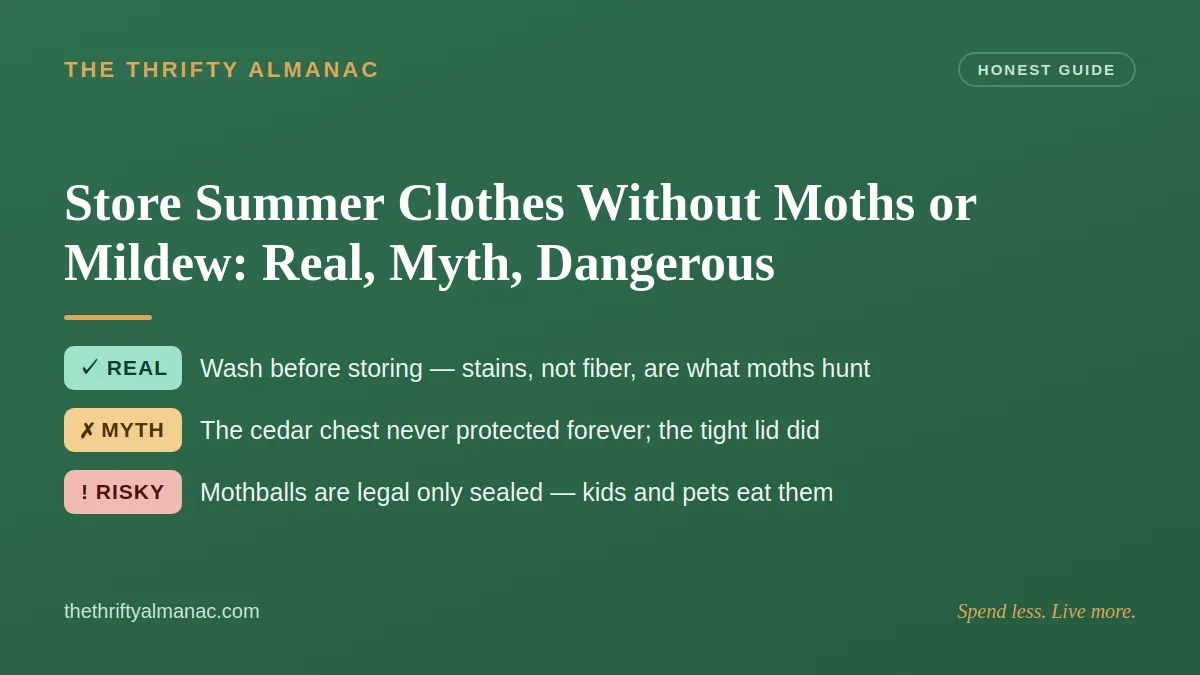
It's late August, the wool is about to disappear into a box for eight months, and most storage advice starts with the box. That's the smallest decision you'll make.
Fabric pests are drawn to what's on a garment as much as what it's made of. Penn State is blunt: synthetics and cottons "are not attacked by the webbing clothes moth larvae unless these items are stained with food or body oils" (Penn State Extension). The ten minutes that decide whether your sweaters survive happen at the washing machine, not the storage aisle.
The step that decides whether your sweaters survive
What: clean every at-risk garment before the lid goes on. How: wash or dry-clean, then dry it completely. Why: Mississippi State says cleaning does two jobs at once — it kills life stages already present, and it makes the item "less attractive to egg-laying moths" (Mississippi State Extension). Sweat and dandruff are the strongest draw; larvae concentrate along seams and stains.
Limit: cleaning protects the item, not the closet it came out of. Colorado State says "dry cleaning kills all stages of the insect" (Colorado State) — but a clean sweater returned to an infested closet is a fresh meal. The budget equivalent, per Iowa State: items "washed in hot soapy water and dried at high temperatures" (Iowa State Extension). Care label first.
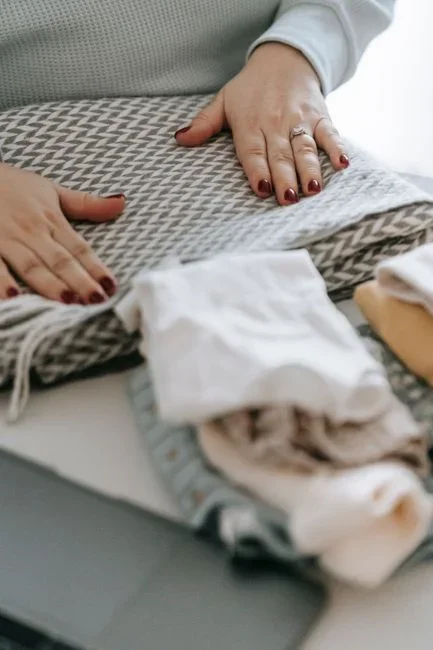
What actually eats wool — and why "it's cotton, it's fine" is half wrong
Two culprits, different appetites. Colorado State says both species of clothes moths "can develop only on woolen fabrics and furs" (Colorado State). Carpet beetle larvae also take silk, leather, fur, pet hair and feathers, and UC IPM says "they don't feed on synthetic fibers" — while adding that "food and perspiration stains on fabrics attract carpet beetles" (UC IPM). The nuance the internet flattens both ways: a clean cotton tee is a poor target, a stained one isn't. Found beetles or shed skins? Sort out which insect you're actually dealing with first.
Damage hides where you don't look. Iowa State points to protected spots "such as under collars, inside hems, on the backside... and inside storage containers" (Iowa State). A whole quiet season is possible: Penn State reports eggs hatch in 4 to 10 days in summer, and egg to adult takes one to three months (Penn State Extension).
The honest tier list
| Tier | Tactic | What the sources support |
|---|---|---|
| REAL | Clean, fully dry garment | Kills life stages, strips the residue moths target |
| REAL | Airtight container | "Clean and pest free" plus a real seal |
| REAL | Cool, stable indoor spot | 65–75°F, humidity near 50% (NPS) |
| PARTLY REAL | Vacuum bags | Great seal; trapped moisture, fold lines |
| PARTLY REAL | Cedar, lavender | Small larvae only, fades over years |
| MYTH | "Cedar chests protect forever" | The tight lid works, not the wood |
| DANGEROUS | Loose mothballs | Off-label use is illegal; kids and pets eat them |
REAL: what the evidence actually backs
Three more, after cleaning:
1. A fully dry garment. National Park Service guidance warns that mold and mildew grow in warm, damp locations and that the brown stains they leave are irreversible (NPS). Wool that feels cool and faintly heavy at bedtime is not dry — give it another day flat.
2. A genuinely airtight container. UC IPM's rule is short: "When storing susceptible items, be sure they are clean and pest free, and place them in an airtight container" (UC IPM). Free upgrade most people bin: Mississippi State notes the dry cleaner's wrapping "will provide additional protection" (Mississippi State). The limit: a seal is only as good as what you sealed in.
3. A cool, stable, indoor spot. Museums store textiles at 65–75°F with humidity as close to 50% as possible, and warn against fluctuations (NPS). That's a professional benchmark, not a number from home closets, but it rules out the losers: a closet shelf beats an uninsulated garage. No spare closet? Renter-safe storage that won't cost your deposit beats paying for a unit.
PARTLY REAL: vacuum bags, cedar, lavender
Vacuum bags work because the seal is the protection. UC IPM warns that if a container "isn't airtight, the chemicals only somewhat repel adults, and any larvae already on clothes continue to feed" (UC IPM). The cautions come from conservation practice, not a test: NPS advises folding as little as possible, since textiles break along fold-lines, and warns about the weight of one textile on another (NPS). No .gov or university source says vacuum bags permanently crush loft — that's a creasing concern, not a finding. A sealed bag also holds whatever humidity went in with it, so the popular bowl-of-salt fix for damp rooms deserves a reality check first.
Cedar does something — less than the marketing implies. UC IPM: aromatic eastern red cedar "contains an oil that can kill small larvae, but it doesn't affect large larvae. After several years, however, cedar loses this quality" (UC IPM). Clemson calls most cedar chests "only marginally effective," and groups lavender with rosemary and mint as oils whose repellent benefit lessens over time (Clemson HGIC). Pleasant drawer, partial protection, declining returns.
MYTH: the cedar chest that protects forever
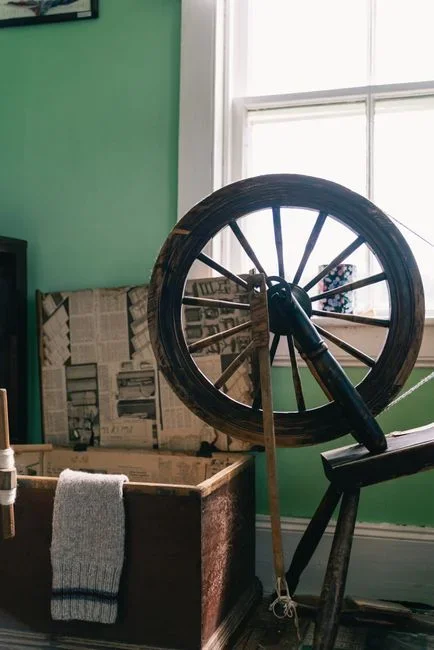
Grandma's chest kept the sweaters intact, so the cedar must have done it. UC IPM says otherwise: "Having a tightly constructed chest is more important in the long run than the type of wood used to make it" (UC IPM). Colorado State adds that cedar chests and mothballs "do repel some moths but will not consistently kill existing insects" (Colorado State). The chest was a good seal with a nice smell.
The drawer full of dryer sheets gets an honest answer too: no extension service or federal source addresses them as a moth repellent, either way. That's an absence of evidence, not proof they fail — and it matters, because the documented alternative costs nothing.
DANGEROUS: mothballs are a pesticide, and the label is the law
Mothballs are a registered pesticide that works by building a lethal gas concentration inside a sealed space. The National Pesticide Information Center says using them off-label "is not only illegal, but can harm people, pets or the environment," and that labels direct users to place them in a tightly closed container (NPIC). As a repellent in the open? NPIC: "No, not unless the label describes that type of use pattern" — they have little or no effect that way (NPIC). In one NPIC case profile, a household scattered them loose in a basement and attic to chase off rats — a use never registered for that product — and someone there developed a headache that wouldn't go away.
Two harms worth memorizing. Children and pets eat mothballs "because they look like candy or other treats," and clothing stored with them and worn unwashed "has caused anemia in infants who wore the clothing, diapers or blankets" (NPIC). Dogs that swallow them may show lethargy, vomiting and tremors. If a child or pet eats one, call Poison Control or your vet immediately.
The two chemicals aren't equivalent. DHHS concluded naphthalene is "reasonably anticipated to be a human carcinogen," EPA calls it a possible human carcinogen, IARC possibly carcinogenic, and red blood cell damage has been reported in exposed people (ATSDR). Paradichlorobenzene has caused "nausea, vomiting, dizziness, fatigue, and headaches," but EPA "has classified it as 'not likely to be carcinogenic to humans'" (NPIC).
So the rule isn't "never." It's: legal only inside a sealed container, kept away from children, with blankets or clothing "aired outdoors and washed before using" — ATSDR's instruction for anything stored with naphthalene (ATSDR). Disposing of an old jar is a local hazardous-waste question — call your county.
The damp side: basements, garages, and what you'll find in spring
An airtight bin in the wrong place is a terrarium. The National Archives sets the numbers: temperature should not exceed 75°F and humidity should not rise above 65%, with 45% to 55% ideal (National Archives). Silica gel can buffer a sealed space, and a musty odor is "often the first indication that a microorganism problem exists." Those targets come from archive practice, not home closets.
Run two separate checks next spring; no source combines them into one tree. First, smell: musty means moisture, and fuzzy growth on the bin or the wall behind it makes mold that has already taken hold the first job. Second, check seams, collars, hems and the container bottom for grazed patches, holes and shed skins.
The late-August changeover, in order
- Sort by fiber. Wool, silk, fur and feather are at risk by default; cotton and synthetics only if stained.
- Clean everything going in. Hot wash and hot dry if the label allows, or dry-clean and keep the wrapping.
- Confirm bone dry. Not "probably dry."
- Seal it, folded as little as the container allows.
- Place it indoors, away from damp basements and hot garages.
- Inspect both ways. Seams, collars, hems, container bottom.
For something already infested, UC IPM lists two non-chemical routes: at least 30 minutes above 120°F, or a plastic bag in the freezer for several days below 18°F for clothes moths (UC IPM). For carpet beetles it's longer — two weeks below 18°F (UC IPM). Durations differ by pest, so match the method to the insect. Both come from pest control, not clothing care: the oven route is unsuitable for most garments and carries a scorch and fire risk, so use the freezer. If the problem returns after cleaning and sealing, call a pest control professional.
Common mistakes
- Storing a "worn once" sweater. One wearing leaves the body oil that draws egg-laying moths.
- Sealing clothes that are still slightly damp. The seal that keeps insects out keeps moisture in.
- Tossing mothballs loose into a closet. Off-label, illegal, documented to hurt kids and pets.
- Wearing naphthalene-stored clothes straight from the box. Air outdoors and wash first, especially anything for a baby.
- Assuming cotton is automatically safe. Stains extend the risk to fibers pests would otherwise ignore.
- Defaulting to the garage. Heat and humidity swings are what conservation guidance warns against.
FAQ
Do I have to dry-clean, or is washing enough?
Colorado State credits dry cleaning with killing all stages of the insect, but Iowa State's hot soapy water plus high-temperature drying is the documented budget equivalent. Follow the care label; "clean and completely dry" is the goal.
Are vacuum bags bad for wool and down?
No authoritative source supports the claim that they permanently crush loft. The verified caution is creasing and compression, plus the moisture a sealed bag traps.
Can I use mothballs if I'm careful?
Only exactly as the label directs: inside a sealed container, never scattered in living space. Air the clothing outdoors and wash it before wearing, and keep the container away from children and pets.
The takeaway: Wash it, dry it completely, seal it, and keep it somewhere cool and stable — the container matters far less than what you put inside it. Spend less. Live more. — The Thrifty Almanac





0comments