

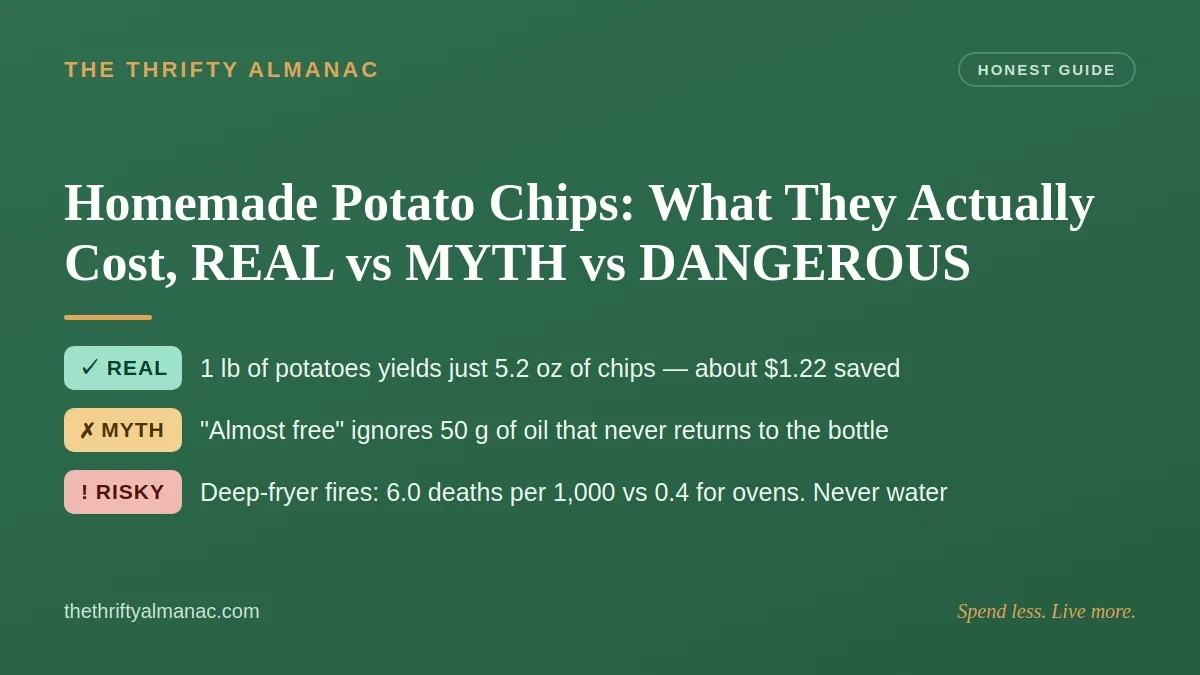
The clip is always the same. One potato, a mandoline, a pot of oil, and a bowl of chips that supposedly cost pennies. The arithmetic never appears on screen.
Run it through the public record and "practically free" shrinks to about a dollar per pound of potatoes — before oil, power and forty minutes of your evening.
The verdict: about $1.22 of headroom, not "free"
In June 2026, white potatoes averaged $0.923 per pound and potato chips $6.632 per 16 ounces. Add the number the clip omits — a pound of potatoes yields only about 5.2 ounces of chips — and the gap collapses.
| Per 1 lb of raw potatoes | Figure | Source |
|---|---|---|
| Potato cost | $0.92 | BLS, June 2026 |
| Chips produced | about 5.2 oz | USDA potato + USDA chip |
| Same weight, store chips | about $2.14 | BLS, June 2026 |
| Left for oil, power, labor | about $1.22 | Subtracted |
That $1.22 is the whole prize, computed from public tables, not a kitchen stopwatch. One caveat: the BLS series covers every bag on the shelf, so kettle-cut and premium brands pull the average up. Against a plain store brand the saving is near break-even. Home cold brew lands in the same place once you price the beans against the bottled stuff, the recurring shape of the kitchen hacks we've run the arithmetic on.
Where three quarters of your potato goes
A raw potato, flesh and skin, is 79.25 g water per 100 g. A finished salted chip is 1.86 g water and 33.98 g fat per 100 g, leaving barely 64 percent as actual potato. So a pound of potatoes carries about 94 g of solids, yielding roughly 147 g of chips — 5.2 ounces, meaning a pound of chips takes about 3.1 pounds of potatoes. The four-pound figure online adds peeling losses; ours is a best case.
The oil is the cost nobody counts
That 147 g of chips holds about 50 g of absorbed frying oil — roughly 3.7 tablespoons — that never goes back in the bottle. Oil is the second ingredient by weight, not an accessory.
No dollar figure: the BLS vegetable oil price series ended in 2005, so no federal one exists. A 48-ounce jug holds about 96 tablespoons, so one batch drinks close to 4 percent — divide what you paid by 25 and take it off the $1.22. Reuse it and that is all you pay; pour a quart away after one batch and homemade costs several times the bag, much as grinding your own peanut butter turns on one unglamorous detail.
Reusing frying oil, by the USDA's actual rules
USDA's Food Safety and Inspection Service makes reuse legitimate: strain through cheesecloth or a sieve, store sealed and light-proof for up to 3 months, refrigerate for best quality. Let the pot cool completely first — straining hot oil is how people get scald burns.
Discarding is a sensory test: clouded, foaming, or a foul odor means it is done — University of Florida Extension describes oxidized oil as smelling "painty" or "fishy". Spent oil goes in a sealed container in the trash, never down the sink.
The limit: USDA gives no number of reuses. The "three to five times" rule online has no authoritative source — a three-month clock and a smell test is all there is.
The same sheet says to skip cast iron, which "breaks down oil faster than other metals," and fill a skillet no closer than 2 inches from the top. Its smoke points:
| Oil | Smoke point (USDA FSIS) |
|---|---|
| Peanut, safflower, soybean | 450°F |
| Grapeseed | 445°F |
| Canola | 435°F |
| Corn, olive, sesame, sunflower | 410°F |
The forty minutes, where the saving disappears
Call it forty minutes of slicing, frying in batches, draining and cleaning — our assumption, not a measurement. At $15 an hour, a rate picked to make the point, that is $10 of your evening chasing $1.22 of groceries. No plausible wage makes this a budget strategy.
Which is fine, if you are honest about why: fresher taste, control of the salt, and using up potatoes before they sprout — the logic behind a pantry that stops food dying at the back of a cupboard. Values, not savings.
Myth: any potato will do
First-timers blame oil temperature when chips come out dark and bitter. Usually it is storage. Research on chipping potatoes finds that at low temperatures, "increased permeability and disintegration of the amyloplast membrane" lets enzymes break starch into sugars, and those sugars brown aggressively in hot oil.
Tubers stored at 8.9°C held their sugars in range and gave the lightest chips; 5.5°C and 7.2°C did not. Dakota Pearl accumulated far less sucrose and glucose than the others, which is why the industry breeds "cold-chipper" varieties. The limit: four North Dakota cultivars in commercial storage, so do not transfer those temperatures to an unlabeled grocery bag. The read holds — room-temperature potatoes fry lighter.
Fridge or cupboard? The guidance has split
American food-safety guidance still says cupboard. Ohio State's food safety program repeats the standard line, "Store potatoes outside of the refrigerator", because cold raises the sugars that form acrylamide.
Britain's regulator no longer agrees: the Food Standards Agency said the same for years, then changed it after its Committee on Toxicity reviewed research finding fridge storage does not materially raise acrylamide-forming potential versus a cool, dark place. Treat it as an open question. For chips it changes nothing: cold potatoes brown faster either way.
Acrylamide, in proportion
Acrylamide rises as fried potato goes from golden to brown, and toxicology bodies call it a probable human carcinogen on rodent evidence. The National Cancer Institute's read of the human data is blunt: epidemiologic studies "have found no consistent evidence that dietary acrylamide exposure is associated with the risk of any type of cancer". Take the cheap habits on their own merits: cook to golden rather than deep brown, and soak the slices 15 to 30 minutes first. Pale chips taste cleaner.
One claim needs retiring: air frying is not the acrylamide-safer option. The study behind it reported every value below its own limit of quantification of 18.20 ng/g, tenfold under the 59–5,200 µg/kg range reported elsewhere for chips and fries. A commentary concludes the treatments cannot be told apart.
The part that can actually hurt you
NFPA counts an average of 158,400 home cooking fires a year — 44 percent of all home fires — with 470 deaths and 4,150 injuries. USFA, on a different dataset, counts about 170,000 cooking fires and 135 deaths, unattended equipment behind 37 percent. Cite each to its own agency.
Frying is not the most frequent cause: unattended cooking leads at 28 percent, ranges or cooktops at 53 percent. It leads on severity — 6.0 deaths and 42.8 injuries per 1,000 fires, against 0.4 and 11.5 for ovens. Where cooking materials ignited, oil, fat and grease went first in 51 percent of cases, causing 53 percent of deaths and 75 percent of injuries.
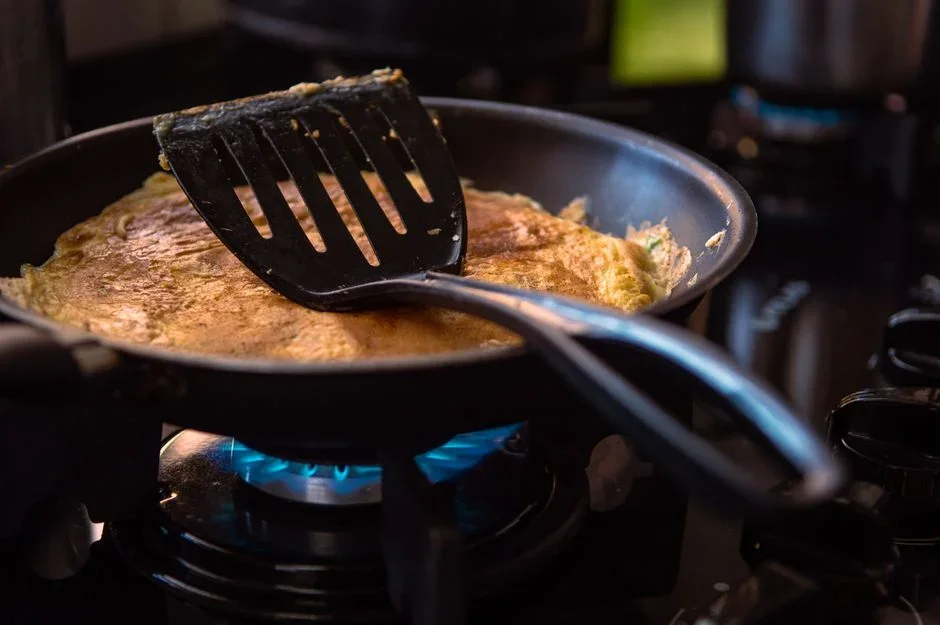
If the oil catches fire: slide a lid over the pan, turn off the burner, leave it covered until completely cool, and call 911. Never water — USDA notes water hitting oil around 350°F "vaporizes instantaneously turning into super heated steam", and Michigan State University Extension agrees: "Grease fires should not be doused with water". Keep an extinguisher in reach; if one motion won't smother it, get everyone out and call the fire department — over half of non-fatal cooking-fire injuries hit people fighting the fire themselves. Frying needs continuous attention: no children underfoot, no pets at the stove, nobody leaving the room.
Air fryer and oven: less oil, not no oil
Cutting the oil removes the largest variable cost and the pot of hot liquid. University of Illinois Extension reports that "air fryers use 70 to 85% less oil than conventional frying methods", circulating hot air carrying fine oil droplets. A sheet pan in a hot oven works the same way.
Less oil is not no oil: K-State Research and Extension describes "only a small amount of oil brushed on the food surface" — with nothing to strain or dispose of. Price the power yourself: watts times hours divided by 1,000, times the 18.44 cents per kWh US average for May 2026. Two limits: it buys oil cost and fire safety, not acrylamide reduction, and no federal source publishes sample wattages, so use your machine's nameplate.
Make them, or buy the bag
Make them when you have potatoes to use up, want the salt under your control, and will strain and store the oil. Buy the bag when you are optimizing money or time.
| Verdict | Claim | What the record shows |
|---|---|---|
| REAL | Cheaper than the average bag | About $1.22 per pound of potatoes, before oil and labor |
| REAL | You control the salt | About 773 mg a batch, against a 2,300 mg daily ceiling |
| MYTH | "One potato, basically free" | 1 lb yields 5.2 oz, and 50 g of oil vanishes into it |
| MYTH | Air frying is acrylamide-safer | Its study read below its own limit of quantification |
| DANGEROUS | Walking away from the pot | Unattended cooking: 28% of cooking fires |
| DANGEROUS | Water on a grease fire | Deep fryers: 6.0 deaths per 1,000 fires vs 0.4 for ovens |
A batch is roughly 780 calories and 773 mg of sodium — a third of the 2,300 mg daily limit, against an American average above 3,400 mg. The sodium is yours to set; the calories are not.
Common mistakes
- Budgeting for potatoes and forgetting the oil, the second ingredient by weight.
- Dumping a quart of oil after one batch, turning a saving into a loss.
- Trusting a "reuse it 3 to 5 times" rule no agency publishes.
- Straining oil while it is still hot instead of letting the pot cool.
- Frying in cast iron, or filling a skillet closer than 2 inches from the rim.
- Using a mandoline without the hand guard.
- Leaving the pot to answer the door, or reaching for water when oil ignites.
FAQ
How many times can I reuse the frying oil?
No authoritative count exists. USDA allows up to three months when the oil is strained, sealed light-proof and refrigerated, plus a discard test: clouded, foaming or off-smelling means finished.
Are homemade chips healthier than the bag?
Partly, on one axis. You control the salt, which matters when so much dietary sodium arrives through commercially prepared food. You do not control the calories: a third of any fried chip is absorbed oil.
What do I do if the oil catches fire?
Slide a lid over the pan, turn off the burner, leave it covered until cool, and call 911. Never water, and never carry a burning pan outside. If one motion won't smother it, get everyone out.
The takeaway: Homemade potato chips are a taste-and-salt upgrade with a small rebate attached, not a money strategy — and the rebate only survives if you reuse the oil and never leave the pot. Spend less. Live more. — The Thrifty Almanac



0comments