

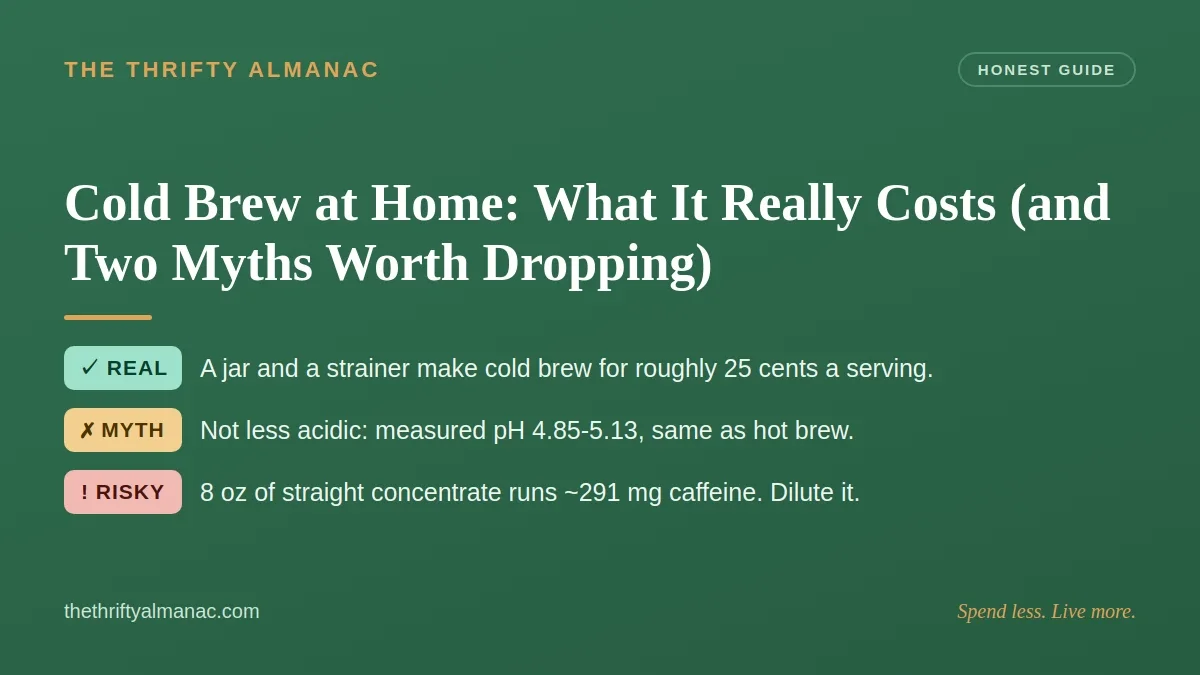
Somebody on your feed has done the math on cold brew, and the number is suspiciously round. Thirty cents a cup. Quit the coffee shop, buy a brewer, retire early.
The frugal half is roughly right, and we'll show the arithmetic. The wellness half is backwards: both health claims riding along with the trend are contradicted by the same peer-reviewed lab, and the real hazard never makes the caption.
The number everyone quotes, and where it comes from
An honest cost-per-cup starts with the Bureau of Labor Statistics average-price series for ground roast coffee. In June 2026 the U.S. city average was $9.457 per pound, down slightly from $9.511 in May and $9.723 in April. Coffee got expensive, which is why the math matters.
We won't tell you what a cold brew costs at your shop. No government series tracks the price of a cup bought out, so any "$6 latte" figure is a guess dressed as data. Bring your own receipt.
Cost per cup, calculated in the open
A pound is 453.6 grams, so at $9.457 per pound you pay about 2.08 cents per gram. The published research uses a 1:10 ratio — 35.0 g of coffee in 350 mL of water — so about 73 cents of coffee per batch. Cut it 1:1 and you have roughly 700 mL, just under three 8 oz servings: near 25 cents a serving. Straight, an 8 oz pour costs about 49 cents — and undiluted concentrate has a second problem, below.
Our assumptions, not measurements. Bean price is the whole ballgame:
| Coffee price per lb | Coffee cost per 350 mL batch | Per 8 oz, diluted 1:1 |
|---|---|---|
| $6.00 (below average) | $0.46 | ~$0.16 |
| $9.457 (BLS June 2026 average) | $0.73 | ~$0.25 |
| $15.00 (above average) | $1.16 | ~$0.39 |
The limits: coffee only — no water, ice, milk, filters or electricity, and no allowance for liquid absorbed by the grounds, so real yield runs slightly worse. The BLS series is ground roast, all sizes, national average; it says nothing about whole bean or your zip code. Illinois Extension also notes cold brew "uses more coffee grounds, which is why it can be more expensive" per batch than drip.
It's the accounting we run on every DIY-versus-store question in our series on household swaps. Sometimes homemade wins; sometimes, as with the detergent-from-scratch trend, it doesn't.
The gear tier list: why a cold brew maker never pays for itself
University of Illinois Extension puts the equipment question plainly: you can "buy a cold brew coffee maker, use a French press or simply use a large glass jar and a cheesecloth."
That demolishes the payback pitch. All three routes take the same grams of coffee and make the same drink, so a purchased brewer has no payback period against the jar — savings versus the correct baseline are zero, forever. "Pays for itself in six weeks" compares the device to a coffee shop, not to your cabinet.
| Tier | Method | Honest verdict |
|---|---|---|
| S | Glass jar + fine-mesh strainer or cheesecloth | Same drink, same coffee cost, $0 if you own it |
| A | French press you already own | Identical result, filter built in, no purchase |
| C | Purchased cold brew maker | Convenience only — never breaks even against the jar |
| F | Anything sold as a "cold brew system" | Solves a problem a strainer already solved |
The limit: we're not pricing gear — prices go stale fast. And the jar has a real tradeoff: you filter by hand, and mesh leaves more sediment than a purpose-built filter. That's the convenience you'd be buying, not a saving. We earn nothing by recommending a jar; the same math governs grinding your own nut butter, where the machine is the expensive part of a cheap habit.
Myth: cold brew is less acidic
This is the claim that sells the trend, and direct measurement doesn't support it. Researchers at Thomas Jefferson University measured the pH of matched cold and hot brews and found them comparable — cold brew 4.96 to 5.13, hot brew 4.85 to 5.10. Same neighborhood — nowhere near a two-thirds difference.
It gets worse, because "acidity" means two things. pH measures how strong the acid is; titratable acidity measures how much is present. On that second measure the study found hot brew carried higher titratable acidity — the one real difference points opposite to the slogan. The same lab measured lower antioxidant activity in cold brew too.
The awkward part: the Illinois Extension page we cited for equipment also repeats "It's 67 percent less acidic than regular coffee!" We're disagreeing with a university source on the strength of direct measurement — that's how far this claim traveled.
The limit: that brew was steeped at room temperature (21–25 °C) for 7 hours at 1:10, not fridge-steeped overnight like most home recipes. And to be clear about what we are not saying: no clinical evidence we found shows brewing method changes reflux or stomach upset in either direction. The acidity claim is unsupported — that's the finding, not a health tip.
Myth: cold brew is the gentler, lower-caffeine option
Inverted, not softened. At an identical 1:10 ratio, the 2017 measurements put cold brew at the high end:
| Roast / grind | Cold brew (mg/L) | Hot brew (mg/L) |
|---|---|---|
| Medium / coarse | 1230 ± 60 | 970 ± 70 |
| Medium / medium | 1180 ± 90 | 1040 ± 70 |
| Dark / medium | 1080 ± 70 | 1060 ± 70 |
| Dark / coarse | 990 ± 30 | 840 ± 10 |
Coarse-grind cold brew came out substantially higher. The conversion: an 8 oz pour is about 237 mL, so undiluted medium-roast coarse-grind concentrate at 1230 mg/L works out to roughly 291 mg per glass. UNH Extension puts a typical 12 oz cup at about 113 to 247 mg.
The critical caveat: the study's hot brew was a French press run at that same 1:10 ratio — concentrate strength, not the far more dilute pour a drip machine makes. This is a like-for-like lab comparison, not concentrate versus your usual mug; your jar shifts with roast, grind, ratio and steep time.
The dose problem nobody mentions when they hand you a jar
Concentrate is an ingredient, not a serving. FDA considers 400 mg of caffeine a day safe for healthy adults. One 8 oz glass of undiluted concentrate at our calculated ~291 mg is three-quarters of that. Cut it 1:1 and the same glass lands near 146 mg, an ordinary cup of coffee.
MotherToBaby notes that most experts suggest limiting caffeine to 200 mg or less per day during pregnancy, and 300 mg or less while breastfeeding, watching the infant for agitation, poor sleep or rapid heart rate. A single straight pour clears the pregnancy figure outright. If you're pregnant, nursing, caffeine-sensitive or on stimulant-interacting medication, ask your clinician, not an unlabeled jar.
The real hazard: cold brew never gets a kill step
Hot brewing heats the water; cold brewing doesn't, so nothing kills what arrived on the grounds or in the jar. Cornell's Food Venture Center notes that hot brewed coffee has "some inhibitory compounds" the cold process never produces, and states the problem directly: "At a pH of 4.6 or below C. botulinum cannot produce the toxin" — and coffee, per the measurements above, sits at 4.85 to 5.13, the wrong side of that line. Sealing out oxygen makes it worse: doing so "created an environment where anaerobic bacteria... are able to grow." New York inspectors have required nitro keg product be discarded within 24 hours of manufacturing.
Three rules. South Dakota State Extension's guidance below is written for cold-brewed tea, not coffee, but the hazard logic — no heat step, pH above 4.6 — carries.
- Steep and store in the fridge, not on the counter. The brew should be "immediately refrigerated to <40F" and kept under constant refrigeration.
- Start with a clean, sanitized jar. The container "should be cleaned and sanitized prior to use."
- Never vacuum-seal, can, or nitro-charge it at home. The container "should not be anaerobically sealed such as vacuum sealing, water bath canning, or pressure canning." Sealing a low-acid, unheated beverage is the one move that can genuinely hurt someone.
The sources disagree on shelf life, and we won't invent a number. Illinois Extension says it "can be stored in the refrigerator for up to two weeks"; Cornell favors prompt consumption. No FDA or USDA figure exists for homemade cold brew, so treat two weeks as the outer edge and brew what you'll finish in a few days.
Stop steeping for 24 hours
The useful finding buried in the caffeine study: caffeine and chlorogenic acid reached equilibrium by first-order kinetics between 6 and 7 hours, against the 10 to 24 hours typical methods specify. Overnight is fine because it's convenient, not because the chemistry demands it; Illinois Extension's 16 to 24 hours is a taste convention, not an extraction requirement.
The limit: equilibrium was measured for caffeine and 3-CGA specifically, at room temperature and 1:10. Flavor keeps developing after caffeine stops climbing, and fridge steeping runs slower. Steeping longer for taste is fine; "it needs 24 hours to get strong" is not. To make it stronger, add grounds, not hours.
Common mistakes
- Buying the brewer first. The jar makes the same drink from the same coffee; the device buys convenience, never savings.
- Drinking concentrate straight. Roughly 291 mg in an 8 oz glass by our calculation — three-quarters of the 400 mg a day FDA calls safe for healthy adults.
- Steeping on the counter. No kill step plus a pH near 5 means the fridge is doing real work.
- Vacuum-sealing or canning a batch to "keep it fresh." The one step that turns a thrift habit into a hazard.
- Choosing cold brew for your stomach. The measured pH doesn't support the pitch, and we found no evidence of a digestive benefit.
FAQ
Is home cold brew actually cheap?
On our arithmetic from the BLS June 2026 average, about 25 cents a serving diluted 1:1, coffee only. A cheaper bag brings that near 16 cents; pricier beans push it past 39.
Does cold brew have less caffeine than hot coffee?
At matched 1:10 strength, no — cold brew measured 990 to 1230 mg/L against hot brew's 840 to 1060. That's a lab comparison at equal ratio, not concentrate versus your usual drip mug.
Is cold brew easier on my stomach?
We can't tell you that. The pH claim behind it is contradicted by direct measurement, and we found no clinical evidence linking brewing method to reflux or stomach upset. That's for your doctor, not your jar.
How long does homemade cold brew keep in the fridge?
Sources conflict and there's no federal number. Illinois Extension says up to two weeks refrigerated; Cornell favors prompt consumption. Brew small and drink it within a few days.
The takeaway: Cold brew is a genuinely cheap habit made with a jar you already own, but it is not lower in acid, not lower in caffeine, and not a countertop food. Spend less. Live more. — The Thrifty Almanac



0comments