

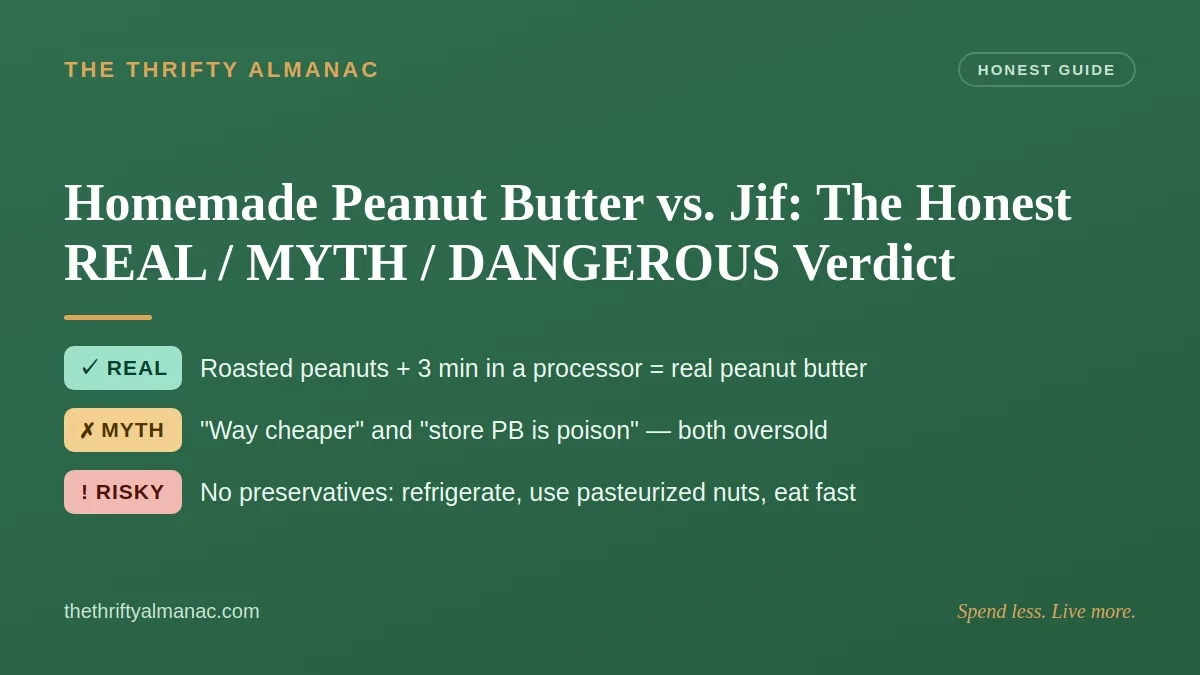
You've seen the video: "Jif doesn't want you making your own peanut butter — they hid how easy it is." It's a great hook. It's also mostly wrong. Making peanut butter at home is genuinely easy, but it's a well-known technique, not a suppressed secret. Jif even sells its own natural line.
So let's do what we do here: separate what you actually gain from what the videos oversell. Here's the honest tier-list up front.
| Verdict | The claim | The honest truth |
|---|---|---|
| REAL | You can make peanut butter from just peanuts | True. Roasted peanuts, 2-3 minutes in a food processor. No sugar, oil, or salt unless you add it. |
| MYTH | It's way cheaper, and store PB is dangerous chemicals | Savings are usually modest, and the jar's additives are small, FDA-permitted amounts — not poison. |
| DANGEROUS | Homemade is simply safer and better | No preservatives means it separates, goes rancid, and needs refrigeration — plus real nut-safety rules. |
REAL: you genuinely can make it from just peanuts
This is the part the videos get right. Roasted peanuts blended for a few minutes release their own oil and turn into smooth peanut butter. That's it. You control the salt, and you can add none at all.
Compare that to the jar. Jif Creamy's full label reads: roasted peanuts, sugar, and 2% or less of molasses, fully hydrogenated vegetable oils (rapeseed and soybean), mono and diglycerides, and salt. A plain-peanut homemade version skips the sugar, the stabilizer oils, and the added salt. If "fewer ingredients" is your goal, homemade wins cleanly — the same way it does with a lot of DIY swaps we've put under the microscope.
Just don't call it a hidden secret. It's an honest, simple upgrade for people who want a shorter ingredient list and fresher taste.
MYTH #1: "It's way cheaper" — do the honest math
This is the biggest oversell. Peanut butter is a commodity, and so are peanuts. Unless you buy peanuts in real bulk, the price per pound often lands in a similar range. The same commodity math shows up in homemade potato chips, where a pound of potatoes cooks down to only about five ounces of finished chips.
Here's the problem with putting a hard number on it: there is no current authoritative retail price to quote. The U.S. city-average BLS retail series for creamy peanut butter was about $2.48 per pound in December 2017 — and that series was discontinued after that date. So treat any dollar figure, including that one, as historical context, not today's shelf price.
Do the math yourself with your own numbers. If a jar costs $Y per pound and raw roasted peanuts cost $X per pound, your savings are simply the gap — minus your time and the electricity to run the processor. The same arithmetic settles whether a jug of homemade cold brew really beats the coffee-shop cup. Call it illustrative: if peanuts run close to what a jar costs per pound, you're saving pennies, not dollars. If you find peanuts genuinely cheap in bulk, the gap widens. Either way, price-check both at your own store before you believe a "save a fortune" claim. Frugal wins come from honest arithmetic, the same lesson behind the best old-school money habits — not from a viral promise.
MYTH #2: "Store peanut butter is dangerous chemicals"
Be fair to the jar. The additives are real, but they're small and permitted. Per 2-tablespoon serving, Jif Creamy has 2g added sugars, 140mg sodium, and 3.5g saturated fat (17% of the Daily Value). Those are modest amounts, not toxins.
What about the scary-sounding "mono and diglycerides" and "fully hydrogenated vegetable oils"? Those are stabilizers. Fully hydrogenated oil is not the partially hydrogenated kind linked to trans-fat worries — full hydrogenation leaves negligible trans fat. Its job is purely mechanical: keep the peanut butter uniform.
The honest knock on the jar is "more additives," which is a perfectly good reason to prefer homemade. The dishonest knock is "poison." Don't let a video talk you into the second one.
Why the jar doesn't separate (the stabilizer trade-off)
That hydrogenated oil is exactly why store peanut butter stays smooth and shelf-stable for a long time while your homemade batch develops a layer of oil on top.
The science is straightforward. Stabilizers form a network of hard fat crystals that suspend the peanut solids so they don't settle — research on peanut butter describes this crystal matrix as the reason commercial product resists separation. Take the stabilizer out and physics takes over: one storage study found peanut butter showing more than 2% oil separation after 12 weeks without a stabilizer. That's the natural oil-on-top layer you'll stir back into any homemade or "natural" jar.
So the trade-off is honest and simple: additive-free and fresh, or uniform and stable. Neither is evil. It's just a choice.
DANGEROUS: the food-safety rules the hype skips
This is the part the videos never mention, and it's the part that actually matters. Homemade peanut butter has no preservatives, so you own the safety.
Refrigerate it and eat it fast
Nuts contain fat that turns rancid over time, giving an "off" taste. Illinois Extension notes that refrigerating or freezing slows how quickly those fats go rancid, which is why even "natural" peanut butters often say to refrigerate after opening. Practical rule: keep homemade in the fridge and use it within a few weeks. That's a reasonable inference from the rancidity guidance, not a precise dated guarantee — trust your nose over the calendar.
Use pasteurized nuts
Peanuts are low-moisture, but they can still carry Salmonella. South Dakota State University Extension is direct about this: to make safe nut butter you should use pasteurized nuts, and the FDA recommends a minimum 5-log pathogen reduction for peanuts. Standard store-bought roasted peanuts are heat-treated. Raw, foraged, or backyard nuts are not — don't shortcut this one.
Buy quality peanuts, store them cool and dry
Aflatoxins are toxins made by certain molds found on crops including peanuts, and the National Cancer Institute notes exposure is associated with increased liver-cancer risk. Keep this in proportion, though: that same source notes the FDA tests peanuts and peanut butter, and to date no outbreak of human illness from aflatoxins has been reported in the U.S. Translation: the commercial jar is monitored; the practical home risk is poorly stored raw peanuts.
The molds thrive in warm, humid conditions — Clemson's guidance points to peanut moisture above about 8% and temperatures over 25°C (77°F) as the danger zone for aflatoxin growth. You don't need a moisture meter at home. Just buy fresh, quality peanuts, keep them cool and dry, and toss any that smell off, taste bitter, or look moldy.
One note on allergies
Making peanut butter yourself does not reduce peanut allergenicity in any way. If peanuts are a household allergy concern, homemade is no safer than store-bought — treat it with the same care.
Bottom line: gains vs. trade-offs
| What homemade genuinely gives you | What the jar gives you |
|---|---|
| Fewer ingredients (just peanuts, salt if you want) | No oil separation, smooth every scoop |
| Fresher, more roasted taste | Long shelf stability, no refrigeration needed |
| Full control over salt and sugar | Grab-and-go convenience |
| Sometimes modestly cheaper in bulk | Commercial aflatoxin/pathogen monitoring built in |
Make it if you value freshness and a short ingredient list and you'll eat it quickly. Buy it if you want convenience and stability. No conspiracy required — and if this kind of honest DIY math is your thing, the same clear-eyed approach runs through our whole home hacks playbook.
Common mistakes
- Believing the "huge savings" hook. Price-check peanuts and a jar per pound at your store first; the gap is often small.
- Leaving homemade on the counter. No preservatives means it separates and goes rancid — refrigerate and eat within a few weeks.
- Using raw or foraged peanuts. Stick to pasteurized, store-bought roasted nuts to avoid Salmonella.
- Ignoring how peanuts smell. Bitter, musty, or moldy nuts go in the trash, not the processor.
- Calling the jar "poison." The additives are small, permitted amounts. "More additives" is the fair critique; "toxic" isn't.
FAQ
Is homemade peanut butter actually healthier than Jif?
It has fewer added ingredients — no added sugar, salt, or stabilizer oil unless you include them. That's an ingredient-composition difference, not a proven health-outcome difference. The honest claim is "simpler," not "medically healthier."
Why does my homemade peanut butter separate and the store kind doesn't?
The jar contains a fully hydrogenated stabilizer oil that forms fat crystals suspending the peanut solids. Yours has none, so the natural oil rises to the top. Just stir it back in.
How long does homemade peanut butter last?
Refrigerate it and plan to use it within a few weeks. There's no single sourced expiration number — rely on refrigeration and a smell/taste check, since the fats turn rancid over time.
Do I really need pasteurized peanuts?
Yes. Standard roasted store-bought peanuts are already heat-treated, which handles pathogen risk. Raw or backyard nuts are not — don't use them for homemade nut butter.
Should I worry about aflatoxin in peanut butter?
Not for the average U.S. commercial jar, which the FDA monitors. The real caution is homemade batches made from poorly stored raw peanuts. Buy fresh, store cool and dry, and discard anything off.
The takeaway: Homemade peanut butter is real and simple, but it wins on ingredients and freshness — not on dramatic savings or safety — so make it for taste and refrigerate it, or keep the jar for convenience. Spend less. Live more. — The Thrifty Almanac



0comments