

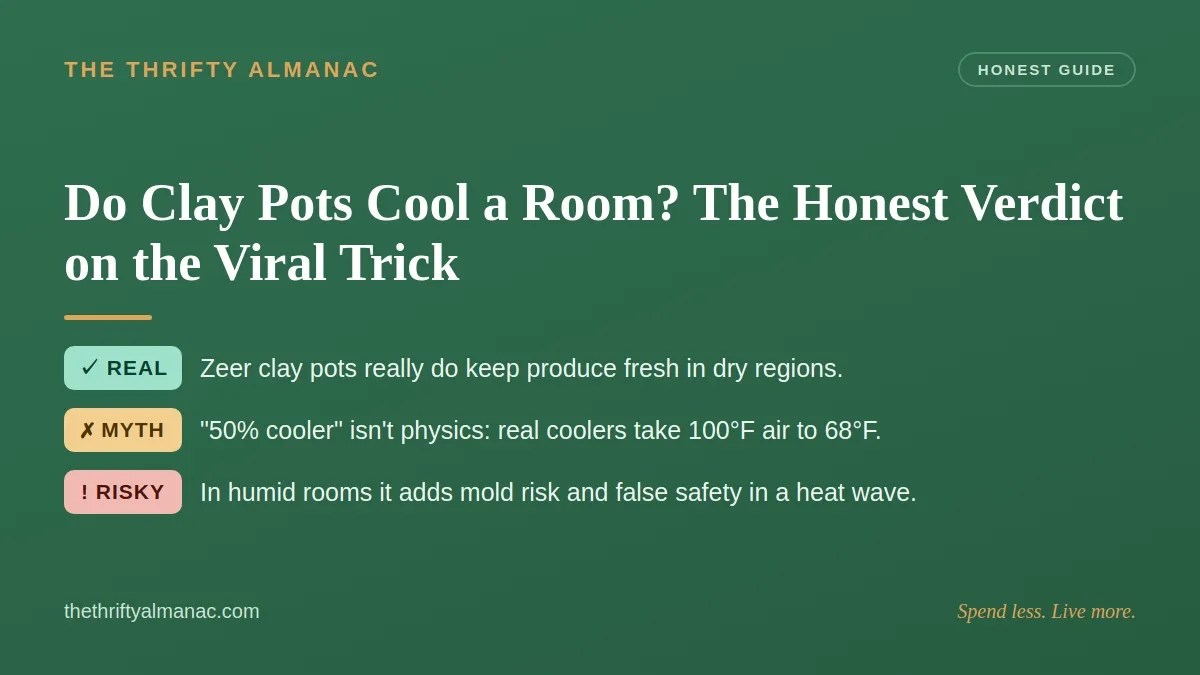
You have seen the video. Two terracotta pots, one nested in the other, wet sand between them, water poured in — and a caption promising a room "50% cooler" with no electricity and no bill.
The honest answer up front: the physics is real and well documented, the "50% cooler room" is not, and in humid air in a closed room this setup makes things worse. If you want a bedroom you can sleep in tonight, start with the full menu of what actually cools a room — this page explains why the pot trick is not on it.
The part that's real: evaporative cooling is genuine engineering
Water absorbs a large amount of heat as it turns to vapor, pulling that heat from the air touching it. Two very different industries run on that fact.
The clay pot for food
The pot-in-pot cooler, or zeer, is a real, studied device. MIT D-Lab, which has run these programs in Mali, Kenya and Rwanda, describes them as providing a cool humid environment for produce, extending the shelf life of leafy greens from one or two days to more than four. A peer-reviewed clay cooler study measured 24–29°C inside the chamber against 32–40°C ambient air.
Read that carefully. Those numbers describe a small enclosed chamber of vegetables — a low-tech refrigerator, not a living room. If saving produce is the real goal, our guide to keeping food cold without a fridge shows where this device earns its place.
The swamp cooler for air
Scaled up and given a fan, the same principle becomes the evaporative or "swamp" cooler, which really does cool desert houses cheaply. University of Arizona CLIMAS researchers compared a Tucson home on each system: the swamp cooler drew about 250 kWh a month against 850 kWh for air conditioning, roughly $25 versus $85 on the bill. That advantage is genuine where the climate allows it.
Where "50% cooler" falls apart
A percentage change in temperature is not a physical statement. Fahrenheit and Celsius both put zero in an arbitrary place, so identical cooling gives a different percentage depending on the scale you use.
Take the best case CLIMAS documents: an 85%-efficient swamp cooler cooling 100°F daytime air to about 68°F. In Fahrenheit that is a 32% reduction; the same air in Celsius, 37.8° to 20°, is 47%; in Kelvin it is under 6%. Same air, same machine, three "percentages."
Degrees dropped is the honest unit. Arizona Cooperative Extension gives an indoor swamp cooler a maximum drop of 20°F at 100°F and 10% humidity — the ceiling for a powered machine ducted through a house, not for pots on a nightstand.
The number nobody mentions: how much water has to evaporate
Cooling is proportional to water evaporated, the cleanest reason this cannot scale. CLIMAS measured a 4,500 CFM cooler on low speed serving a 2,000-square-foot Tucson home: 128 gallons evaporated per day. Arizona Extension logs 7.5 gallons per hour for 1,500 square feet in dry air.
| What | Water moved | What it cools |
|---|---|---|
| Swamp cooler, Tucson (CLIMAS) | 128 gallons evaporated per day | 2,000 sq ft home |
| Indoor swamp cooler, dry air (AZ Extension) | 7.5 gallons per hour | 1,500 sq ft, 20°F max drop |
| A pair of decorative clay pots | A gallon or two, total capacity | No published measurement exists |
No one has published a room-temperature measurement for pots of water in a bedroom, and we have not tested them. What the engineering record establishes is scale: a machine drinks gallons per hour to move a room; two pots hold a couple of gallons, total.
The ceiling your climate sets: wet-bulb temperature
Evaporative cooling has a floor it can never pass: the wet-bulb temperature, the coldest air can get by evaporating water into it. The clay cooler study says it plainly — the minimum temperature reachable is the wet bulb temperature of the incoming air. Muggy air already carries water and accepts little more, so that floor rises to meet the ceiling.
Arizona Extension's table shows the cost: in dry air the indoor swamp cooler drops temperature 20°F, but at 90°F and 50% humidity it manages 10°F while air conditioning holds 40°F in both.
| Conditions | Swamp cooler | Air conditioning |
|---|---|---|
| Dry: 100°F, 10% RH | −20°F temp, +40% humidity | −40°F temp, no humidity change |
| Humid: 90°F, 50% RH | −10°F temp, +30% humidity | −40°F temp, −30% humidity |
Greenhouse engineering agrees. University of Florida IFAS calculates an 85%-efficient pad system at 90°F and 50% humidity only reaches 76.5°F, because Florida afternoon wet bulb often sits at 79–80°F; Illinois Extension puts Midwest summer wet-bulb depression at 14 to 20°F. Those are greenhouse and livestock figures, but the principle governs any evaporative device — and such systems need fans giving one complete air change per minute. Still pots in a shut room have neither the airflow nor the exit path.
Where it backfires: humidity, mold, and air that feels worse
Raising humidity is not a side effect of this trick. It is the trick. Arizona Extension defines evaporative cooling as evaporating water to reduce air temperature and increase air humidity, measuring +40% relative humidity in dry air and +30% even in humid monsoon air. The clay cooler study logged its chamber at 92% relative humidity against 40.3% ambient. You cannot buy the cooling without the moisture.
Set that against EPA's line for a house: keep indoor humidity below 60 percent, ideally 30 to 50 percent, because humidity above 60 percent is likely to result in condensation, which can lead to mold growth. When outdoor air is warm and humid, EPA's instruction is to dehumidify — the opposite of what a pan of evaporating water does. If damp is already your problem, you want the cheap ways to pull moisture out of a room, not a device built to add it.
The comfort failure arrives long before the mold. The National Weather Service defines the heat index as how hot it really feels once humidity is factored in: at 96°F with 65% humidity it feels like 121°F. Adding moisture pushes you up that scale — you lose more in feel than you gain in degrees.
The dangerous part: leaning on this during a heat wave
This is why the article exists: someone who believes their room is being cooled may stay in it when they should leave. EPA is specific — do not use electric fans for cooling when room temperature is in the mid-90s or higher, and do not use an electric fan in a closed room — and NWS limits fan use to heat index temperatures below the high 90s. A fan behind wet pots in a shut bedroom hits both warnings. EPA names those most at risk as adults 65 and older, infants and children, people with chronic conditions, people without air conditioning, and outdoor workers — and CDC notes those groups become ill more quickly.
Know the two levels. Heat exhaustion, per NWS, brings heavy sweating; weakness; cool, pale, clammy skin; cramps; dizziness or nausea — move to a cooler, preferably air-conditioned space, apply cool wet cloths, sip water, and get medical care if vomiting starts or symptoms last past an hour. Heat stroke brings confusion, slurred speech, body temperature above 103°F, hot skin, loss of consciousness, and the instruction is not negotiable: call 911 or get the person to a hospital immediately, and do not give fluids. CDC notes body temperature can reach 106°F within 10 to 15 minutes.
For a home without working cooling, EPA says go where cooling exists — cooling centers, malls, libraries. That costs nothing, and it works.
So when does it actually make sense?
Try it if: you are storing produce off-grid in a dry climate and build a proper zeer — pot in pot, damp sand, wet cloth lid, in shade. Or you live in dry air and are weighing a real evaporative cooler with a blower, a water line, and a cracked window so moist air escapes.
Skip it if: your climate is humid, your room stays closed, or the heat is already dangerous.
The verdict
| Tier | Claim | Why |
|---|---|---|
| REAL | Evaporative cooling works, and a zeer preserves vegetables in dry regions | MIT D-Lab and chamber studies document it; swamp coolers use about 250 kWh a month against 850 |
| MYTH | "Clay pots make a room 50% cooler, no electricity" | Percent-cooler is not a physical quantity, and the best machine needs 128 gallons a day and a fan to reach 68°F |
| DANGEROUS | Trusting pots to keep a room safe in a heat wave | Pushes humidity toward EPA's 60% mold line, raises the heat index, and can keep a vulnerable person in a room they should leave |
Method note: this verdict comes from the published engineering and public health record — Arizona Extension, CLIMAS, UF IFAS, EPA, NWS, CDC — not from us testing pots. No one else has published that measurement either.
What actually cools a room — the honest list
- Block sun before it enters, with exterior shade and closed blinds on sun-facing glass.
- Flush the house at night once outdoor air drops below indoor air, then shut it at dawn — the rhythm old houses were built around.
- Point fans at people, not rooms, inside EPA's limits.
- Attack top-floor heat at its source, ranked in our guide to why upstairs bakes.
- When heat turns dangerous, use air conditioning or a cooling center.
Common mistakes
- Treating a percentage of temperature as real. Ask for degrees dropped instead.
- Confusing a food cooler with a room cooler. The zeer's documented job is a storage chamber.
- Running it in a closed room. Without airflow and an exit for humid air, you have built a humidifier.
- Believing terracotta is special. Clay only wicks water to a wide surface; the cooling is the water leaving.
- Skipping a real heat plan because a gadget feels like it is working.
FAQ
Will clay pots lower my room temperature at all?
By an amount you are unlikely to feel, and no published study measures it. The wet surface of two pots is tiny beside the 128 gallons a day an engineered cooler evaporates. In dry air, standing next to it, you may notice slight coolness — a local effect, not a cooled room.
Does adding a fan behind the pots fix it?
Airflow is genuinely required, so a fan helps the mechanism — but it creates no surface area, and it walks you into EPA's warnings: no fan in a closed room, and none once the room reaches the mid-90s.
Could this cause mold in my bedroom?
It pushes you the wrong way. EPA wants indoor humidity under 60 percent and warns that above that line condensation and mold follow. A device whose purpose is adding moisture belongs outdoors or in dry air, not beside a bed.
The takeaway: The evaporation is real, the "50% cooler" is not, and in humid air you buy mold risk and a higher heat index for a degree you will never notice. Spend less. Live more. — The Thrifty Almanac





0comments