

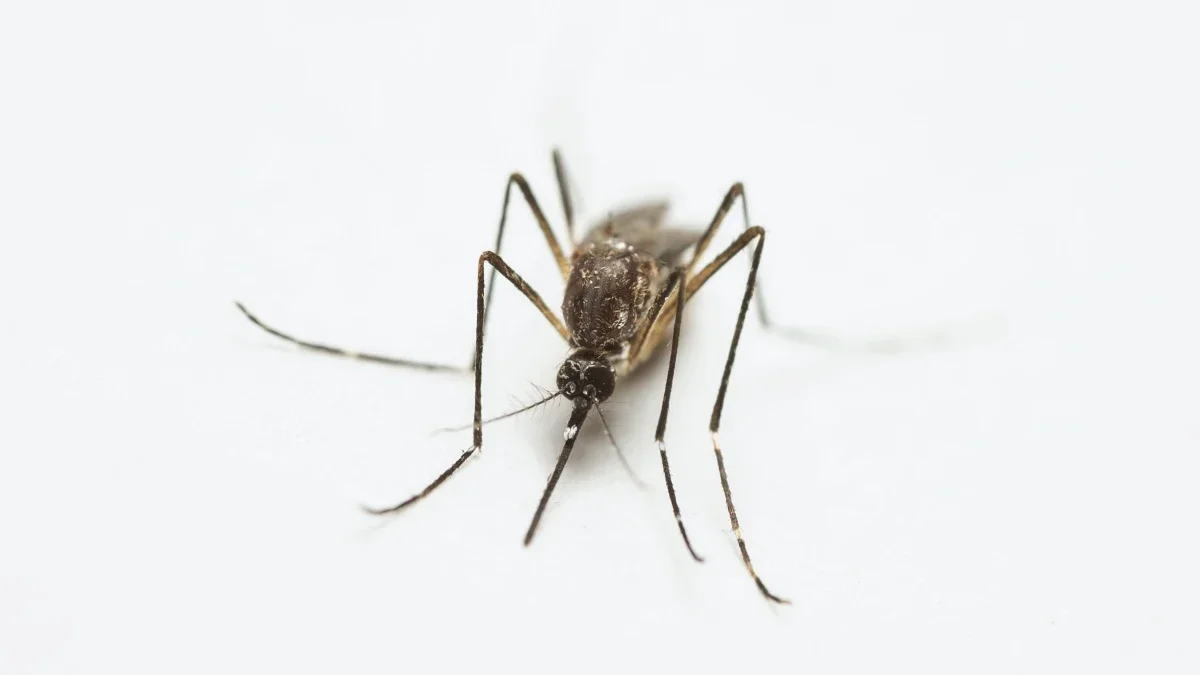
You are sitting on your own patio at dusk, and the mosquitoes find your ankles. Here is the part almost every "kill every mosquito" video skips: the container-breeding mosquito biting you probably did not fly in from the woods. The yellow-fever mosquito (Aedes aegypti) and its backyard cousins are homebodies — one meta-analysis pegged their average flight range at just about 106 meters, and the CDC notes these mosquitoes "live close to humans." So the cloud around your chair most likely grew up in your own yard, in a few cups of still water you walk past every day.
That changes the whole fight. You are not battling the neighborhood; you are managing the standing water within a stone's throw of your back door. The old Amish and farm-family way did exactly that, in the right order, for pocket change. None of it is a fake-"Amish guy" secret — it is source reduction and a soil bacterium, the same tools county mosquito districts use, fact-checked here against the EPA and CDC rather than a suspiciously high-production persona.
The order that actually works: drain, dunk, then the stragglers
The single most common mistake is doing this backwards. People start by spraying the adult mosquitoes — the one step that barely moves the needle — then wonder why the yard still hums. The yard gets cleared at the water, not in the air. Run it in this order, cheapest and most effective first:
- Level 1 — Drain it (free). Once a week, tip out every container holding water.
- Level 2 — Dunk it (roughly $3 a month). For water you can't pour out — a rain barrel, a boggy corner, a pond edge — drop in BTI.
- Level 3 — Deal with the stragglers (last). Only now bother with the adults still drifting in.
This is a system, not a silver bullet. Skip levels one and two and jump to spraying, and you have done the least-effective thing first. Do levels one and two well, and the third barely matters.
Level 1 — Tip and toss: the free weekly walk
WHAT: Once a week, on the same day, you turn over everything in the yard that holds water — plant saucers, tarps, kiddie pools, clogged gutters, old tires, buckets, the dog's water bowl, the wheelbarrow. Tip it, toss the water, set it upside down.
HOW: Pick a fixed day so you don't forget — for most yards the whole loop takes only about fifteen minutes. If you want proof it matters, look inside a bucket that has sat a week: the little dark commas twitching at the surface are mosquito larvae. That bucket is a nursery.
WHY it works: A mosquito goes from egg to biting adult in about 7 to 10 days in warm weather, and it takes only a small amount of standing water — as little as a bottle cap's worth — to raise a brood. Dump that water every seven days and you cancel the next generation before it can fly. Clearing standing water this way is the first thing the CDC tells you to do — because it is the thing that works.
LIMIT: It only handles water you can see and reach. It does nothing for a rain barrel you want to keep, a permanently soggy low corner, or a backyard pond. That water is exactly what Level 2 is for.
Level 2 — The cheap BTI bucket, and why it's safe for bees and pets
WHAT: For water you can't drain, you add BTI — sold as mosquito "dunks" or granules. BTI is Bacillus thuringiensis subspecies israelensis, a naturally occurring soil bacterium. A typical disc treats roughly 100 square feet of water surface and lasts about 30 days — but check your own product's label, because coverage, disc life, and price all vary by brand. Replace it monthly through the season and it usually works out to around $3 a month.
HOW: Drop a dunk in the rain barrel, at the edge of the pond, in the boggy spot that never dries, and at the base of a downspout that pools. Mark a monthly reminder on the calendar so the fresh dunk goes in before the old one quits. That's the whole job.
WHY it works — the part other articles skip: BTI carries tiny protein crystals that do nothing until they hit the right kind of gut. A mosquito larva's gut is strongly alkaline, and only inside that alkaline digestive tract do the crystals activate into a toxin that punches holes in the larva's gut wall, killing it within about a day. Think of it as a key cut for exactly one lock. Bees, fish, birds, dogs, and people all have acidic guts, so the crystal never activates in them — and they lack the specific receptor the toxin has to lock onto. That is why BTI, first registered by the U.S. EPA in 1983, is rated non-toxic to people, with the EPA also finding minimal toxicity to honey bees after decades of study. It is the same bacterium the county pros use to treat marshes and storm drains — the professional's tool at the homeowner's price.
LIMIT: Three honest caveats. First, BTI kills only larvae, not adults already in the air, so you will not see results overnight — you watch the cloud thin over a week or two as no new mosquitoes hatch. Second, a barrel you are actively dosing with larvicide is not a drinking station; BTI is considered safe at label rates, but give the dog its own clean bowl and keep treated water in the rain barrel or pond only. Third, never pour BTI into a natural creek, stream, or any wild moving water — it is gentle, but it also kills the larvae of midges and blackflies that fish and birds eat. Treat only the contained standing water in your own yard.
Level 3 — Adults, box fans, and the essential-oil myth
WHAT: This level is for the adult mosquitoes still drifting into your seat — and for being honest about the home-mixed sprays all over the internet.
HOW: Point a plain box fan across the seating area where you sit. That's it for the cheap, reliable option.
WHY the fan works: Mosquitoes are weak fliers. A steady breeze physically keeps them off you and scatters the plume of carbon dioxide they home in on, for pennies of electricity. It is the honest, low-cost adult control.
Now the myth. The overpromise most top videos run on is a home-mixed essential-oil spray that will supposedly "kill every mosquito" or "wipe out every mosquito in your yard." It won't. The CDC does not recommend pure, unformulated (home-mixed) essential oils as repellents — they have not passed the safety-and-efficacy testing that registered repellents go through. Outdoors, they evaporate and scatter within minutes. A spray might buy you a little skin time; it will not clear a yard.
LIMIT: This is the least-effective of the three levels, which is exactly why it comes last. A fan protects only the specific spot where you are sitting — it is not a yard treatment. And any product promising to "wipe out every mosquito" is selling you the overpromise, not the outcome.
One more old trick: the smoke (smudge) method
WHAT: A small smoldering pot of damp herbs or punk wood, set upwind of the porch at dusk — the same idea as a campfire that keeps the bugs off one side of the group.
HOW: Use an existing fire pit or a metal pail with something already on hand — dried sage, rosemary, or damp yard trimmings that smolder instead of flame. Place it upwind on a still evening so the smoke drifts across where you sit. Keep any open flame or smoldering pot well away from dry brush, and never leave it unattended.
WHY it works: The smoke doesn't poison the mosquitoes. It jams the carbon-dioxide and body-heat signals they use to find you, so you stop reading as a target in the haze.
LIMIT: It only protects the patch of air the smoke actually drifts through, and it does nothing on a breezy night when the smoke blows away. Treat it as a nice bonus on a calm evening, not a plan.
Does this actually cut bites, or just kill larvae?
This is the question competitor videos leave hanging, so here is the straight answer. Because a backyard container mosquito barely leaves the yard — that roughly 106-meter range again — killing the larvae in your own water genuinely thins the biting cloud over a week or two. It is not a theoretical "fewer larvae" win; fewer larvae in your yard means fewer new adults hunting your ankles. The catch, honestly, is that it works on your own exposure. A heavy breeding source on the property right next to you can still send some mosquitoes over the fence, so a very buggy neighbor sets a floor on how quiet your yard can get.
The honest recap and the safe order to run it
The reframe first: most of the container mosquitoes biting you were born in your own yard, usually within a few hundred feet of your chair. So you win at the water, in this order:
- Weekly (free): the roughly fifteen-minute tip-and-toss walk, same day every week, to cancel the next generation.
- Monthly (about $3): a fresh BTI dunk in every bit of water you can't drain — barrel, pond edge, boggy corner, downspout.
- As needed (last): a box fan where you sit, and a smudge pot on a calm night. Skip the essential-oil sprays.
Give it a week or two. You are not looking for an overnight kill — you are watching the cloud thin as no new mosquitoes hatch.
Common mistakes recap
- Doing it backwards — starting with adult sprays instead of draining and dunking first.
- Believing a home-mixed essential-oil spray can "wipe out every mosquito"; it evaporates outdoors in minutes and won't clear a yard.
- Expecting overnight results — BTI kills larvae, not the adults already flying, so the cloud thins over a week or two.
- Skipping the weekly walk — even a bottle cap's worth of water left sitting a week is enough to breed the next batch.
- Treating a dosed rain barrel as the dog's water bowl instead of giving the dog its own clean bowl.
- Pouring BTI into a natural creek or stream, where it also hits the midges and blackflies fish and birds feed on.
FAQ
Is BTI safe if my dog drinks the treated water?
BTI is considered safe at label rates, and it doesn't activate in an acidic mammal gut. But a barrel you are actively dosing with larvicide is not a drinking station. Give your dog its own clean bowl and keep the treated water in the rain barrel or pond only.
How long until I see fewer mosquitoes?
Expect roughly one to two weeks. BTI only kills larvae, so the adults already in the air have to live out their lives while no new ones hatch behind them. You'll watch the cloud thin, not vanish overnight.
Do the essential-oil sprays in those videos work?
Not as a yard solution. The CDC does not recommend pure, home-mixed essential oils as repellents, and outdoors they evaporate within minutes. Your money and effort do far more at the water — drain it, then dunk BTI.
Is this really an "Amish" secret?
The methods — dumping standing water, treating the water you keep, and smoke at dusk — are genuinely old farm-family practice. But there's no secret persona here. It's source reduction plus a soil bacterium, checked against the EPA and CDC, which is why it holds up.
The takeaway: drain the water you can for free, drop a roughly $3 BTI dunk in the water you can't, deal with the adult stragglers last, and give it a week or two to work — the mosquitoes biting you were born in your own yard, so that's where you win. Spend less. Live more. — The Thrifty Almanac





0comments