

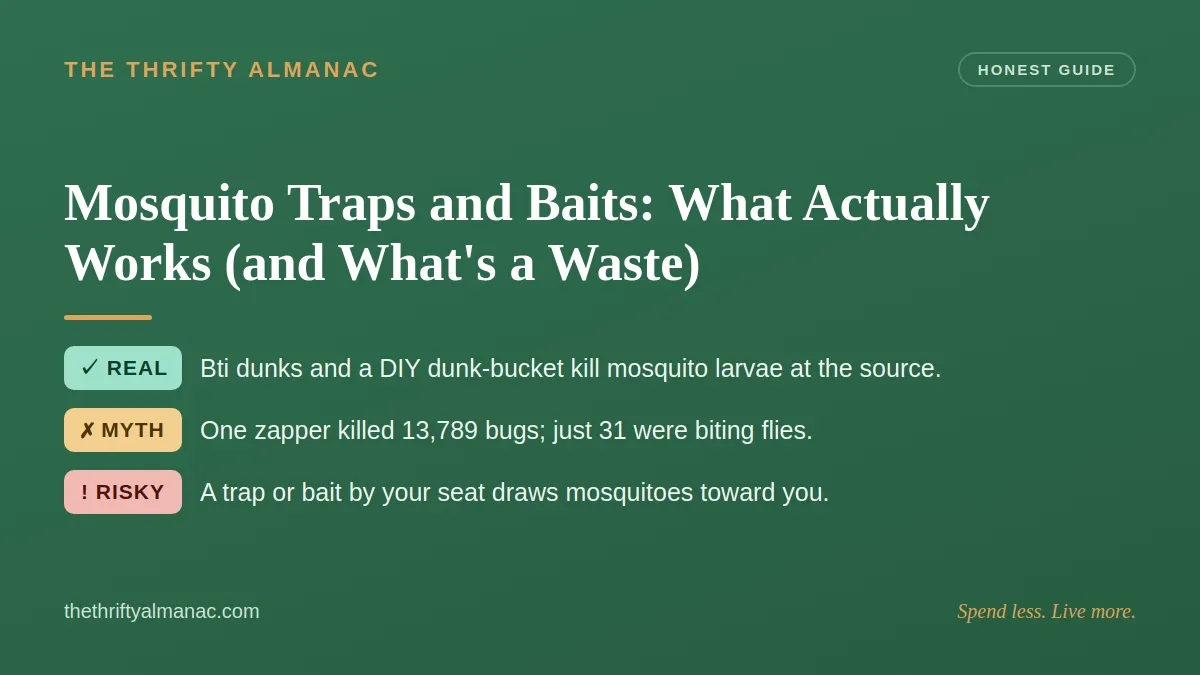
Somewhere on your feed, a video promises a homemade bait mosquitoes "can't resist" — a jar of sugar water, a glowing bulb, a trap that clears the yard by morning. One dramatic device, zero bites. The real fix is quieter and cheaper: killing larvae in standing water and protecting your skin, the full routine of which is in our Amish-style drain-and-Bti guide. This piece answers the other question — which of the gadgets and DIY traps are worth it. Sorted our usual way: WORKS, MYTH, or DANGEROUS. No named product has an authoritative efficacy test, so every verdict judges the mechanism — attractant, larvicide, or sound — not a brand.
| Device / bait | Verdict | Why |
|---|---|---|
| DIY gravid "dunk-bucket" (with Bti) | WORKS | Lures egg-laying females and kills the next generation |
| Bug zapper | MYTH | Kills almost everything except mosquitoes; can pull more in |
| Ultrasonic apps / sonic repellers | MYTH | No measurable effect; mosquitoes don't hear these sounds |
| Single-backyard CO2/UV trap | MURKY | Catches plenty of bugs; not shown to cut bites in one yard |
| Attractant trap or bait near seating | DANGER | Draws mosquitoes toward the people it's parked next to |
Why mosquitoes ignore your gadgets
A female mosquito finds you with three signals: the carbon dioxide you breathe out, your body heat, and skin chemistry like lactic acid. She does not track ultraviolet light the way a moth does, and she is effectively deaf to the tones "sonic" gadgets emit. University of Florida entomologists note that mosquitoes lock onto the CO2 in your breath and ignore the UV bulb, which is why a device built around a glowing light misses them (UF/IFAS). Anything betting on sound or light is fighting the mosquito's biology — which is why the only home "trap" with real science behind it works on the water, not the air.
WORKS: the DIY gravid "ovitrap," done right
This is the one homemade trap that holds up — a lure-and-kill bucket, not a gadget. K-State Extension publishes a "dunk bucket": a 2-to-5-gallon bucket half-filled with water, a handful of grass clippings so it smells like the stagnant water females want, and a Bti Mosquito Dunk to kill whatever hatches, refreshed with a quarter-dunk every 30 days (K-State Extension). The Bti is the entire point: K-State warns that "without maintenance, buckets can become breeding sites instead of preventing mosquitoes." Skip the dunk or the screen and it's not a trap — it's a nursery. (Bti in any standing water you can't drain is the workhorse behind this; the drain-and-dunk routine is covered in the main guide.)
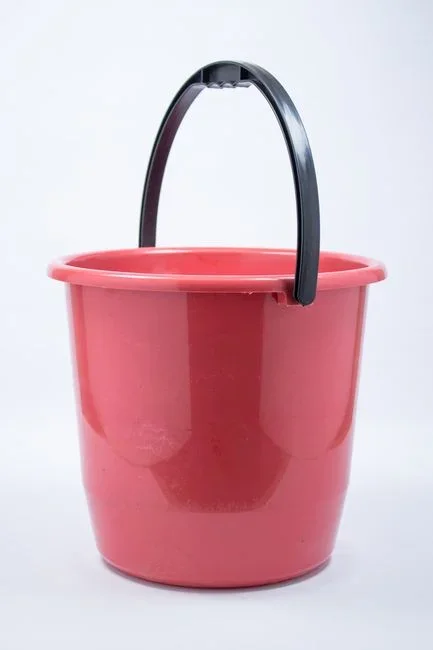
Does it scale? Yes — with coverage. A CDC study using autocidal gravid ovitraps (a black bucket with a sticky screen that catches egg-laying females) deployed 3 to 4 traps per household across about 81% of homes and cut female Aedes aegypti captures by 53% to 70%, at roughly $12.50 in materials per trap (CDC study). The catch: those numbers come from high-coverage neighborhood programs against a container-breeding urban species. One bucket in one yard doesn't clear the block — it stacks the odds, and works best when neighbors run one too.
MYTH: bug zappers — 13,789 bugs, 31 mosquitoes
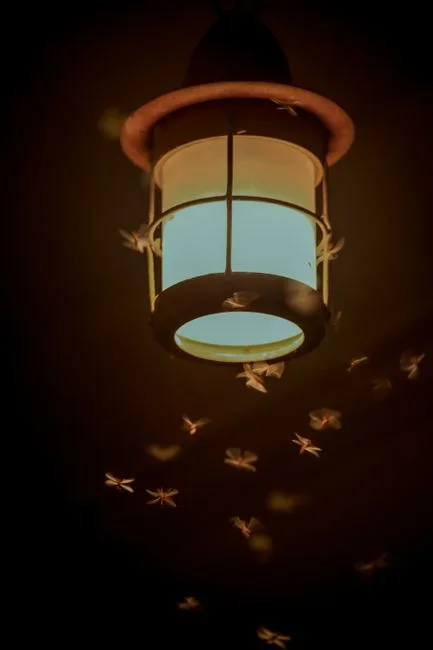
That satisfying blue zap is a machine killing the wrong insects. University of Delaware researchers counted 13,789 insects electrocuted by bug zappers over one summer — and just 31 (0.22%) were biting flies like mosquitoes; nearly half were harmless aquatic insects, and 13.5% were predators that eat pests (Iowa State Extension). A University of Florida field test told the same story: one zapper killed about 10,000 insects in a night, of which only 8 were mosquitoes — and because zappers pull insects in with light while mosquitoes track your CO2, a zapper can draw more mosquitoes into your yard than you started with (UF/IFAS). These studies are from the 1990s, but no newer research has overturned them.
MYTH: ultrasonic apps and "sonic" repellers
The free phone app that claims to shoo mosquitoes with a high whine, and the plug-in that promises the same, both bet on a sense mosquitoes don't hunt with. A Cochrane systematic review of 10 field studies found electronic and ultrasonic mosquito repellents have no effect on preventing bites, and concluded flatly that they "are not effective in repelling mosquitoes and should not be recommended or used" (Cochrane review). "No effect" isn't "harmful" — the real cost is opportunity: every evening you trust a silent app is one you skipped a method that works. The scent claims fare no better; see the essential oils for pests rundown.
MURKY: commercial CO2 and UV traps — big catch, small shield
The expensive propane and CO2 suction traps genuinely catch mosquitoes, sometimes a lot. But catching isn't protecting. The American Mosquito Control Association reports that trap studies could not demonstrate any meaningful reduction in biting pressure, that backyard use hasn't translated into effective control, and — the important part — that a CO2 trap "may actually draw more mosquitoes into an area than they can possibly catch" (AMCA). It's the coverage principle in reverse: one backyard unit is too little coverage to lower the population, and just enough attractant to concentrate mosquitoes where you set it. AMCA's advice: treat traps as an adjunct to repellents and source reduction, never a stand-alone fix.
DANGER: the ways traps and baits backfire
- An attractant parked where you sit. A DIY sugar-and-yeast bait makes CO2 by fermentation — a real mosquito attractant. Set beside your chair, it pulls mosquitoes toward the people it should lure away (AMCA). If you build one, keep it at the far edge of the yard.
- Water with no kill switch. Any container you fill becomes a nursery within days unless it has a lethal element — Bti dunk or sticky screen, every time (K-State Extension).
- Leaning on the gadget instead of your skin. A device that "looks like it's working" leaves you exposed while you skip what actually cuts bites.
What to do instead of buying a gadget
The CDC's own list of recommended methods doesn't include bug zappers, ultrasonic apps, or CO2 traps at all — it's an EPA-registered repellent (DEET, picaridin, IR3535, or oil of lemon eucalyptus) plus weekly source reduction: emptying, scrubbing, covering, or tossing anything that holds water (CDC). That two-part baseline — protect your skin, kill the water — is the whole routine, walked through step by step in the main mosquito guide. The same weekly water-dumping habit also cuts down on ticks in your yard.
FAQ
Do bug zappers kill mosquitoes at all?
A tiny fraction. One field test logged just 8 mosquitoes out of about 10,000 kills (UF/IFAS), and another counted 31 biting flies among 13,789 insects (Iowa State Extension). They can even draw more mosquitoes toward your yard.
Are CO2 traps a scam?
No — they really do catch mosquitoes. But AMCA finds a single backyard trap doesn't meaningfully cut bites and may pull more in (AMCA). It's a coverage-and-placement problem, not a fake one.
What's the cheapest thing that actually works?
A Bti dunk in standing water, or the DIY dunk-bucket above — paired with repellent on your skin. The full routine is in the main guide, and the one already circling your bedroom at 2 a.m. calls for the indoor version of the job.
The takeaway: skip the zapper, the app, and the lone backyard CO2 trap — the only home "trap" worth building is a Bti dunk-bucket, and even that works best alongside repellent and weekly water-dumping. Spend less. Live more. — The Thrifty Almanac





0comments