

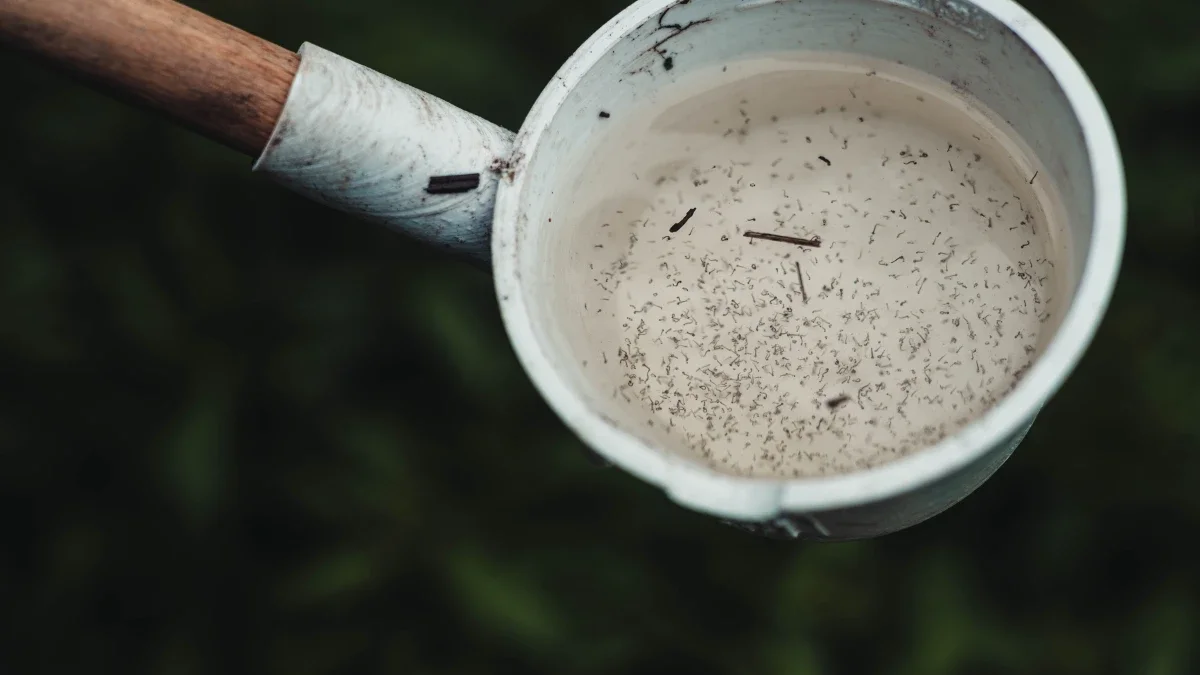
Every June the advice sounds the same: if you have a mosquito problem, go find the pond. People walk the back fence line looking for swamp, buy a zapper, fog the shrubs, and stay puzzled when the biting never lets up. The nursery was never the far corner of the yard. It was a bottle cap by the back step, a saucer under a flowerpot, a sag in the grill cover.
Mosquitoes do not need much water, and the University of California's Integrated Pest Management program puts the number bluntly: "Any small amount of standing water, perhaps even a bottle cap holding water, can support larvae, making detection very difficult" (UC IPM). That one sentence rewrites the whole search. The water breeding your mosquitoes is almost certainly within a few steps of your door, sitting in something you walk past without a second look.
WHAT actually breeds them: standing water, not the pond you pictured
Penn State Extension states it plainly: "Mosquitoes are small, primitive flies that breed in standing water" (Penn State Extension). Standing is the operative word — still, not moving, and it does not need to be big. A female lays her eggs on or right beside quiet water. The larvae, the little comma-shaped "wigglers" you can see hanging at the surface, spend roughly a week feeding there before they emerge as biting adults. Drain the water inside that window and the whole batch dies before anything ever flies.
The mosquitoes that torment you in your own backyard are mostly container breeders — species that specialize in exactly the small, artificial pools of water people create without meaning to. That is why fogging the lawn or lighting a zapper feels like shoveling against the tide. You are swatting at adults in the air while the next generation matures quietly in a plant tray six feet away. Kill the adults and the containers refill the sky within days. Kill the containers and the supply dries up.
The hidden spots most cleanups walk right past

The obvious birdbath gets dumped. It is the water people forget that keeps a yard buzzing. Clogged gutters are the classic offender because you cannot see the standing water from the ground — Penn State's own checklist says to "clean clogged roof gutters every year, especially if leaves tend to plug the drains" (Penn State Extension). Old tires are worse than they look: the same source calls out "used tires, which have become the most important mosquito breeding sites in the country." A single tire in the weeds can out-produce a whole pond.
| Hidden spot | Why it hides the water | The fix |
|---|---|---|
| Clogged roof gutters | Water pools where you can't see it from the ground | Clean out leaves; make sure downspouts drain fully |
| Flowerpot saucers & plant trays | A shallow rim holds water for days after watering | Empty after rain and watering; drill drainage or toss the saucer |
| Tarps, grill covers, pool & boat covers | Folds and sags cradle small puddles | Pull them taut so water runs off, or store them dry |
| Old tires | Curved inside traps water rain can't drain out | Dispose of them, or store under cover so they can't fill |
| Corrugated (ridged) drainpipe extensions | Every ridge holds a spoonful of water | Swap for smooth pipe, or flush and slope so it drains |
| Buckets, wheelbarrows, kids' toys, recycling bins | Left upright, they become rain catchers | Turn upside down or store indoors between uses |
| Trash and recycling can lids, trash-can rims | Concave lids hold a surprising amount | Drill a small hole or keep them inverted |
Notice the pattern: none of these is a body of water. They are objects that happen to hold water, and most of them refill every time it rains. That is the detail the "go find the pond" advice misses entirely.
HOW to break the cycle: "tip and toss," once a week
A one-time cleanup fails for a simple reason — the containers refill and the eggs are patient. The move that actually works is a weekly walk-around, sometimes called "tip and toss": empty every water-holding item, turn it over or store it, and repeat. UC IPM's guidance ties it to the animals' own schedule, advising you to "change water in pet dishes, watering troughs, and bird baths every week" (UC IPM).
WHY a week and not a month: the timing is not arbitrary. From egg to biting adult takes roughly seven to ten days in warm weather, so a weekly dump keeps interrupting the larvae before any of them can grow wings. Skip to every two or three weeks and you are simply letting each batch finish. A ten-minute Saturday loop with the yard-waste bin does more than any spray:
- Walk the perimeter after it rains and tip out anything holding water — saucers, toys, buckets, tarps, wagon beds.
- Scrub birdbaths and pet bowls, not just refill them; mosquito eggs cling to the sides above the waterline and hatch when the water rises again.
- Clear the gutters at least once a season, more if you are under trees.
- Store the rain-catchers upside down so next week's storm has nowhere to collect.
If you want the lowest-cost version of this routine, the frugal-tools angle in our three-dollar mosquito approach leans on the same idea: cut the breeding water first, spend almost nothing.
WHEN you can't dump it: Bti and mosquito dunks

Some water cannot be tipped — a rain barrel you are actually using, an ornamental pond, a fountain, a low spot that stays wet, a birdbath you refuse to give up. For those, the extension and EPA answer is a larvicide called Bti. The EPA describes it as a natural product with a narrow target: "Bti is a biological or a naturally occurring bacterium found in soils," and "it contains spores that produce toxins that specifically target and only affect the larvae of the mosquito, blackfly and fungus gnat" (US EPA). In other words, it poisons the wigglers and leaves the rest of the food web alone. The EPA adds that "Bti can be used around homes in areas and containers where water can collect, such as flower pots, tires, and bird baths," and that "Bti has no toxicity to people and is approved for use for pest control in organic farming operations."
For most homeowners Bti shows up as a floating ring. UC IPM explains the common form: "For situations where screens or completely sealed barrels are impractical, Mosquito Dunks are time-release rings that float on the water surface and contain a bacterial agent (Bti) which kills mosquito larvae, but does not affect people, animals or plants" (UC IPM). You drop a dunk (or a broken piece of one, for a small container) into the water and it keeps working for weeks.
LIMIT — what a dunk does not do:
- It kills larvae only. It will not touch the adult mosquitoes already biting you tonight — that is a different job, covered in what actually works among traps and baits.
- It runs out. A single dunk lasts on the order of a month before it needs replacing, so treated water is not "set and forget."
- Follow the label. Dose to the water volume printed on the package, and be cautious with water you or animals might drink — read the product's directions for that specific use rather than guessing.
The limits: what emptying water won't fix
Source reduction is the single most effective thing you can do in your own yard, and it stops at your property line. It will not drain your neighbor's forgotten kiddie pool, a clogged municipal storm drain, or a natural marsh down the block — those are jobs for your local mosquito-control or abatement district, and a phone call to them is fair game when the breeding is clearly off your land.
The health side deserves plain talk too. Mosquitoes are not just itchy; some carry viruses like West Nile. This article is about prevention around the house, not diagnosis — it is not medical advice, and it is not veterinary advice for your pets. If you or an animal develops a fever, severe headache, or other illness you suspect is mosquito-related, contact a doctor or veterinarian, and lean on your county health department for local risk. For the rest of your outdoor-pest playbook, our DIY pest control guide ties the water work into repellents, screens, and the other layers.
The bottom line

Stop hunting for the pond. The mosquitoes biting you were raised in water you can hold in one hand — a gutter, a saucer, a sagging tarp, a tire, a bottle cap. Walk your yard once a week and tip out everything that holds water, scrub the birdbaths instead of just topping them off, and drop a Bti dunk in the standing water you genuinely cannot drain. That routine costs almost nothing and beats every fogger and zapper on the shelf, because it kills the next generation before it ever gets off the surface of the water.






0comments