

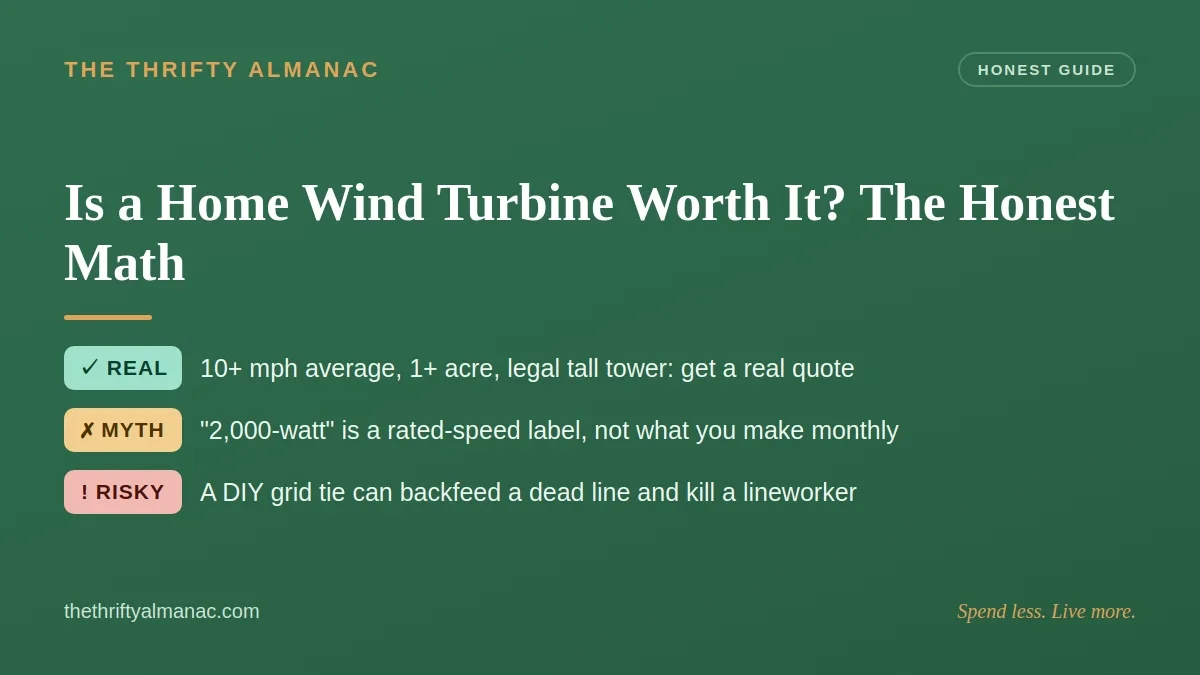
The video is always the same. Someone bolts a propeller to a pole, clips two wires to a battery, and the meter jumps. The caption says the power bill went to zero. What the clip never shows is the one line of arithmetic that decides whether it works — and it has nothing to do with the brand on the box.
We did not buy, install, or measure a turbine. This is a read of the federal paperwork: DOE siting guidance, DOE and NREL cost benchmarks, EIA prices, IRS instructions, OSHA fall rules. Home wind is a location product sold as hardware.
The short answer: three tiers, and most homes land in the bottom two
| Tier | Who this is | Verdict |
|---|---|---|
| REAL | Rural, 1+ acre and a 10 mph annual average, tall tower legal — or a line extension would cost $15,000 to more than $50,000 per mile. | Worth a written quote and a site assessment. |
| MYTH | Ordinary suburban lot, breezy-feeling yard, trees or houses nearby. | The payback story is fiction here. Skip it. |
| DANGEROUS | Anything roof-mounted, or a DIY grid tie without an electrician and a utility agreement. | DOE advises against roof mounting; backfeeding is a life-safety issue. |
Scale check: in all of 2023 the U.S. installed 1,994 small wind turbines totalling 2.3 MW. Solar roofs go up by the hundreds of thousands.
The equation that decides everything
Wind power follows P = ½ × air density × swept area × wind speed cubed. The MIT reference on wind fundamentals calls it "a highly nonlinear cubic dependence on wind speed" — double the wind, get eight times the power. Swept area counts only linearly. And no machine captures it all: the Betz Limit caps the power coefficient at 16/27, about 59%.
DOE turns this into a usable formula: AEO = 0.01328 × D² × V³ — kilowatt-hours per year, D the rotor diameter in feet, V your annual average wind speed in mph. Our arithmetic with it, on a 23-foot rotor: about 12,100 kWh a year at 12 mph, about 5,100 kWh at 9 mph. Three miles per hour costs roughly 58% of the output — same machine, different address. Which is why DOE says output is determined by rotor diameter, not by the generator's nameplate.
Limit: the estimator covers horizontal-axis rotors and ignores turbulence, wind shear and any specific power curve. Screening tool, not a contract.
Check your address before you check a product page
Free, five minutes, and it settles it for most people — the same way we'd start with the no-cost changes that trim a power bill.
- Look your site up on DOE's 30-meter residential-scale wind resource maps.
- Compare against DOE's floor: 4.5 m/s (10 mph) grid-connected, 4.0 m/s (9 mph) stand-alone.
- Apply the obstacle rule: blade bottoms must sit at least 30 feet above any obstacle within 300 feet. A 40-foot tree line 200 feet away means a rotor bottom at 70 feet.
- Confirm at least 1 acre.
Limit: DOE says the maps give a general indication only and can't see your trees or roofline. Only a year of on-site measurement gives real confidence.
"Rated 2000W" is not 2,000 watts a month
Nameplate rating is output at the turbine's rated wind speed — a condition your yard may hit for hours, not months. The honest number is Rated Annual Energy, benchmarked at a 5 m/s (11.2 mph) average. Across DOE's certified models, real production spans 2,920 to 23,700 kWh per year, against an average residential customer's 10,791 kWh a year. DOE says a 5 to 15 kW turbine is what a meaningful contribution takes.
DOE created the Small Wind Certification Council so buyers wouldn't have to trust manufacturer claims. Ask for that certificate in writing; a seller quoting watts and never kWh/year has disqualified himself. Limit: that range is measured at 11.2 mph, above the 10 mph grid-tied minimum, so a site at the floor produces less.
The rooftop turbine is the one clear no
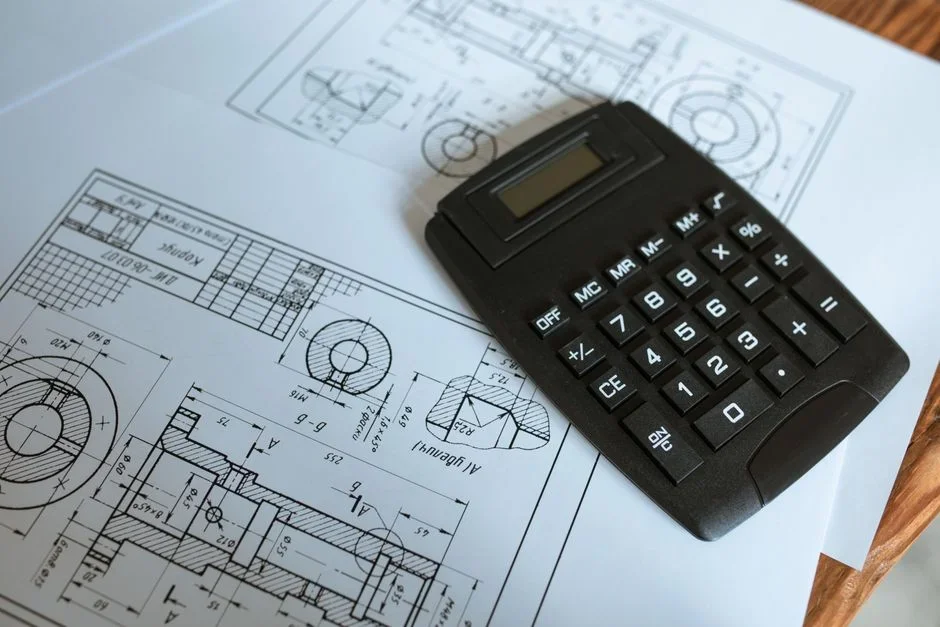
DOE advises against roof mounting on three counts: turbines transmit vibration into the structure as noise, rooftops sit in turbulence that shortens turbine life and cuts production, and it is less cost-effective than a tower.
Put numbers on it. Assume a 4-foot rotor in rooftop air averaging 6 mph; our arithmetic with DOE's formula lands near 46 kWh a year — under nine dollars at EIA's 18.44 cents per kWh (May 2026). If you want outage resilience rather than a smaller bill, price it against a modest battery power station. We've also costed out what a car can realistically run.
Vertical-axis turbines aren't junk, but they aren't new either. Savonius and Darrieus designs are decades old, and DOE says horizontal-axis machines dominate today's market. DOE does fund VAWT research — for floating offshore platforms, where a low center of gravity cuts platform cost; that page also notes early smaller VAWTs underperformed horizontal-axis designs.
Limit: DOE's formula is written for horizontal-axis rotors, so that figure shows the scale of the problem, not a product prediction. No federal source we found quantifies a vertical-versus-horizontal efficiency gap.
The money math, with the 2026 tax reality
DOE's benchmark installed cost is $5,120 per kilowatt — capacity-weighted across just 16 projects in three states in 2021, so a starting point, not a quote. Redo this with your own bill: annual kWh × your rate = savings; installed cost ÷ savings = simple payback.
Assume a well-sited 10 kW system making 12,000 kWh. At 18.44 cents that's about $2,200 a year against about $51,000 installed — call it 23 years, past the 20-year design life before maintenance. Same hardware at 9 mph, and the cube rule pushes payback beyond 50 years. DOE deliberately publishes no typical payback figure.
Two incentive myths need killing. The 30% Residential Clean Energy Credit did cover small wind, but the IRS states you can't claim it for expenditures made after December 31, 2025. And USDA REAP is for agricultural producers and rural small businesses, not homeowners. Check DSIRE for what survives in your state.
Limit: illustrative figures ignoring financing, maintenance and degradation — arithmetic, not tax or investment advice. Confirm the credit with a tax professional.
Same money in solar
| Technology | Federal installed-cost benchmark |
|---|---|
| Small wind | $5,120 per kW (2021) |
| Residential rooftop solar (8 kWdc) | $2.74–$3.15 per watt, Q1 2024 |
Roughly 1.6 to 1.9 times more per kilowatt for wind — before wind's sensitivity to site. A shaded roof still produces a predictable fraction of its potential; sunlight doesn't vary with the cube of anything. Limit: installed cost per kilowatt only; we did not verify a solar output figure.
Where a home turbine genuinely makes sense
You're in the REAL tier if the map puts you at 10 mph or better, you have an acre or more, zoning permits a tall tower, and either your rate sits at 10 to 15 cents per kWh or higher, or you're off-grid — where the alternative isn't a bill but a five-figure trench. Farms and rural small businesses get a second lever: REAP grants can cover up to 50% of eligible project cost. Limit: USDA blocks automated retrieval, so those REAP details come from USDA-domain search results — verify with USDA Rural Development.
The dangerous parts nobody films
Backfeeding. The utility's core concern is that your system automatically stops delivering electricity to its power lines during an outage — otherwise line workers and the public may not take normal precautions and could be hurt or killed. Your turbine must never keep a "dead" line alive. Utilities typically require IEEE 1547 compliance and an interconnection agreement.
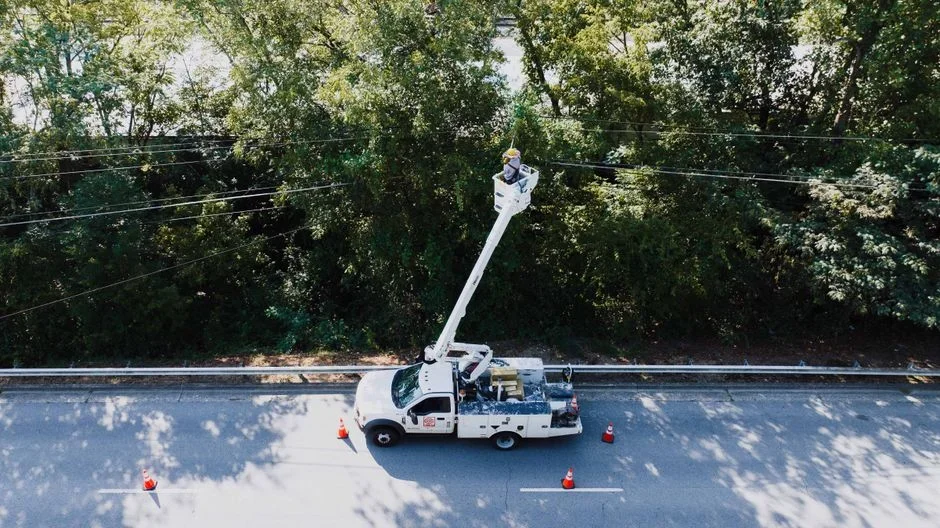
Height. OSHA notes turbines can be over 100 feet tall, and requires fall protection at 6 feet for construction, 4 feet for maintenance, plus landing platforms or a ladder safety device on fixed ladders over 20 feet.
Codes and towers. Local electrical codes apply and the National Electrical Code contains sections specific to small wind installations. Guyed towers need a guy radius of one-half to three-quarters of tower height; setbacks should account for falling ice and thrown parts, so keep driveways and play areas clear. Some utilities require $1 million or more in liability insurance.
DIY. DOE's self-test: can you pour a proper foundation, safely use lifting equipment, tell AC from DC wiring, work safely around electricity, and handle batteries? Any "no" and DOE says hire an installer.
Zoning, noise and neighbors
Most ordinances cap structures at 35 feet in residential areas, and going higher usually means a slow, expensive variance. Notice the collision: the obstacle rule often demands 70 feet and the ordinance allows 35. Noise is milder than neighbors fear: a typical 2 kW turbine runs at about 55 dB 50 feet from the hub. Zoning is hyper-local, so treat this as the pattern, not your town's rule. Call the building inspector first, the utility second, your insurer third, the installer last — the sequencing in our broader home projects guide.
Common mistakes
- Shopping for a brand before checking the wind map. Site beats product.
- Reading nameplate watts instead of Rated Annual Energy in kWh/year.
- Assuming a bigger generator means more power. Rotor diameter drives output.
- Treating a rooftop mount as the modern shortcut. DOE says the opposite.
- Budgeting around the 30% federal credit, dead after 2025, or expecting REAP — a farm program — to pay for a home system.
- Calling zoning after buying, then meeting the 35-foot cap.
- Leaving upkeep out of payback — blades or bearings may need replacing near year 10.
FAQ
How much wind do I actually need?
DOE's floor is a 10 mph annual average grid-connected, 9 mph stand-alone. Gusts you feel on the porch are not an annual average.
Is a home wind turbine cheaper than solar?
Per kilowatt installed, no: $5,120/kW against roughly $2,740–$3,150/kW for rooftop solar. Wind wins on real wind plus land, or distance from the grid — not on price.
Can I install it myself?
Only if you clear DOE's five self-test questions honestly — and the grid tie still needs a licensed electrician and an interconnection agreement. Tower work is fall work under OSHA's rules, and a bad tie-in can energize a line a crew thinks is dead.
What about a small turbine for a shed or cabin?
Off-grid at small scale is the most defensible use: the comparison isn't your bill, it's the cost of running a line. Size it against a certified Rated Annual Energy figure, and have the battery wiring done by a pro.
How did you check all this?
No turbine was purchased, installed or tested. Every figure traces to the linked DOE, NREL, EIA, IRS, OSHA, USDA or MIT document; our arithmetic is DOE's formula, labeled as such. We could not source a primary capacity factor for residential small wind, and USDA's pages blocked automated retrieval.
The takeaway: A home wind turbine is a bet on your address, not on a product — screen the map, the acre and the zoning cap for free before anyone quotes you a price. Spend less. Live more. — The Thrifty Almanac





0comments