

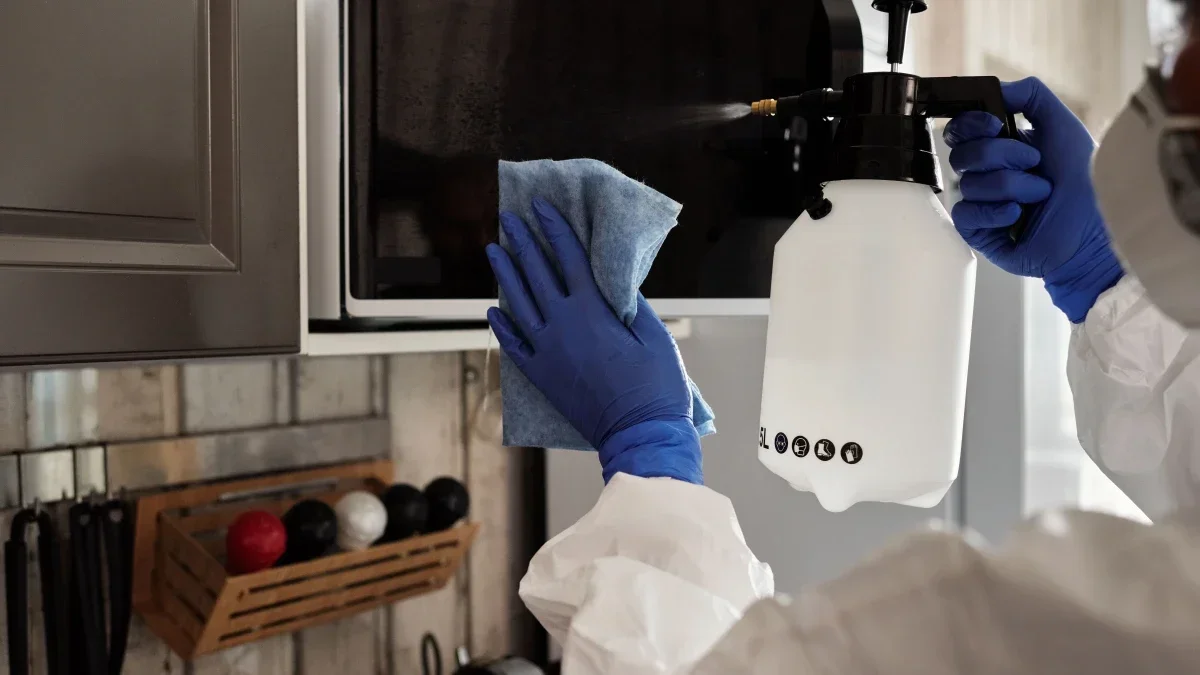
You open the microwave and the inside looks like a small crime scene: sauce welded to the ceiling and a burnt-popcorn smell that never quite left. The honest good news: you do not need a special spray or a long scrubbing session, just a couple of pantry staples that actually clean. A cup of water, a splash of vinegar, and a little steam do almost all the work, softening the gunk so it wipes off instead of fighting you.
This is not a folk trick. The steam-loosen-then-wipe method is essentially what the University of Illinois Extension publishes for caked-on food. What generic cleaning blogs skip is the safety part, so we lead with the how, then the why, then the burn risk you need to respect.
The steam method (what to do)
The whole routine is: make steam, let it sit with the door shut, then wipe. Here is the Illinois Extension version, adapted for a vinegar or lemon mix.
- Fill a microwave-safe bowl. Glass or ceramic only, no metal or foil-trimmed dishes. Add about a cup of water plus a splash of white vinegar. If you prefer lemon, the extension's exact proportion is half a cup of lemon juice to one cup of water. The vinegar is flexible: a good splash is plenty, and there is no magic ratio.
- Heat it until it boils. The extension's instruction is simply to heat "until the mixture boils," not for a set number of minutes, because wattage varies from oven to oven. Look for the liquid bubbling and the window fogging with steam, then stop.
- Leave the door closed until it cools. This is the step most people skip and it is the entire trick. Per the Illinois Extension method, you leave the mixture inside with the door shut until it cools. The trapped steam keeps softening the grime while you do nothing; open too early and the working vapor escapes.
- Remove the bowl with a mitt. It will be hot and the liquid may still be near-boiling. Use an oven mitt or folded towel and set it aside.
- Take out the turntable. Lift out the glass plate and the roller ring under it. Many turntables can be hand-washed in warm, soapy water; check your model's manual before putting one in a dishwasher.
- Wipe from the top down. Start at the ceiling, then the back wall, sides, and floor, so drips land where you have not cleaned yet. The softened food should lift with light pressure; for a stubborn spot, press a cloth dampened in the leftover solution against it, then wipe.
- Get the door and frame, then dry. Wipe the inside of the door and the lip where crumbs collect, then run a dry cloth over everything so you do not leave standing water. Dry the turntable and ring, put them back, done.
Times and amounts are deliberately loose. The sources say "heat until it boils" and "leave until it cools," not precise minutes, so let the steam do the timing.
Why steam and a mild acid do the work
Two plain-physics things happen at once, and neither is magic.

Steam softens the mess. When the water boils inside the closed box, hot vapor fills the cavity and condenses on the cooler ceiling, walls, and door. That moisture soaks back into dried-on food and rehydrates it, so what was welded on lifts with a damp cloth, the same reason a crusty pan is easier to clean after a soak.
The acid helps loosen grease. White vinegar is mildly acidic, basically diluted acetic acid, and that acidity helps break the grip of greasy splatter that plain water tends to smear rather than lift. Note the honest verb: it helps loosen grease, it does not dissolve everything, so a layer of polymerized, baked-on grease may need a second steam and pass.
Safety first: the superheated-water burn risk
According to the FDA, most injuries tied to microwave ovens are heat-related burns from hot containers, overheated food, or exploding liquids, not radiation. The real hazard in this task is scalding, not rays.
The FDA documents that water heated by itself in a smooth, clean cup can become superheated, pushed past its boiling point without appearing to boil. A slight disturbance, like picking it up, can then trigger a violent eruption of boiling water; the FDA notes reports of serious scald burns to hands and faces from exactly this.
Two things reduce that risk, and both are built into this method:
- Add a substance before heating. The FDA notes that adding a substance before heating greatly reduces the superheating risk. Your splash of vinegar or lemon already does this; a wooden stir stick gives bubbles a place to form, too.
- Do not over-heat. The FDA advises against heating liquids longer than the manufacturer instructs. Heat until it boils and stop.
Two more habits while it runs: pull the bowl out with a mitt because the steam and glass are scalding, and do not press your face against a running oven. The FDA also advises not standing directly against the oven (and keeping kids from doing so) for long periods while it operates. Adding vinegar cuts the odds but you still handle hot liquid carefully.
What to use, and what to avoid
- Glass or ceramic bowl only. No metal, no foil, no metal-rimmed dishes, they can arc and spark.
- Soft cloths only. The FDA says specifically not to use scouring pads, steel wool, or other abrasives; they scratch the interior coating. Use a soft cloth, sponge, or paper towel.
- No special cleaner needed. The FDA's own guidance is to clean the cavity, its outer edge, and the door with water and a mild detergent; a special microwave cleaner is not necessary. That is why this costs nearly nothing.
Knocking out lingering odors
Some smells hang around after the surface is clean. Do a second steam first. If a smell persists, reach for baking soda, and here is why it works rather than just masking.
Baking soda is a base. According to the McGill Office for Science and Society, it reacts with acidic odor molecules such as butyric acid to form a non-volatile salt, sodium butyrate, that has no smell, because a molecule must be volatile to reach your nose. That is why baking soda, not vinegar, is the odor tool here: vinegar's own odor effect is weaker and less established. And mixing the two into a fizzing paste is a cleaning myth that mostly cancels itself out.
Two details make the difference. First, give it surface area: the same McGill write-up notes that opening one corner of a box does little, while spreading it on a plate works best, so set an open dish inside the closed, powered-off microwave overnight. Second, it only neutralizes acidic odors, so a scorched-plastic smell may just need the door left open to air out.
Clean is not the same as sanitized
This is where an honest article parts ways with the ones that overpromise. Steam-and-wipe removes visible grime and odor. That is cleaning, not sanitizing or disinfecting, and vinegar is not a reliable germ-killer.
The CDC draws the line clearly: cleaning removes germs, dirt, and impurities with soap and water; sanitizing reduces germs to a level regulators consider safe, using weaker bleach solutions or sanitizing sprays; disinfecting kills remaining germs with stronger chemicals. Vinegar's acetic acid is not one of them; in one peer-reviewed comparison, acetic acid was ineffective at inactivating virus next to bleach, dish soap, and alcohol.

One safety-critical rule if you reach for a disinfectant afterward: never mix vinegar with bleach. Combining an acid like vinegar with bleach releases toxic chlorine gas. Wipe the surface with plain water first, then use the bleach or sanitizer on its own. It is also worth knowing what hydrogen peroxide can and can't disinfect before you reach for it.
A microwave is a food-contact surface. The Illinois Extension warns that bacteria left behind by raw foods spread easily and cause cross-contamination, and that soapy-water washing will not kill all of them. So if you need to sanitize, say after raw-meat spatter, that is a separate step with a proper sanitizer or disinfectant, per the CDC.
Keep it clean so you rarely repeat this
The cheapest fix is not having to clean at all, the same small-habit thinking behind free habits that trim your power bill. Three habits keep buildup from getting stubborn:
- Cover your food while heating. A vented lid, inverted plate, or damp paper towel greatly reduces splatter, and it traps moisture that helps food heat evenly.
- Wipe fresh spills right away. A quick wipe while a spill is still wet saves you the whole steam routine later.
- Do a quick steam now and then. Every couple of weeks for a busy kitchen, monthly for a light one, a rule of thumb, not a rule, keeps grease from building into a hard layer.
Common mistakes
- Opening the door too soon. The steam is still working; leaving it closed until it cools is the difference between wiping and scrubbing.
- Using steel wool or a scouring pad. The FDA says no abrasives, they scratch the interior. Soft cloth only.
- Putting metal in the microwave. No foil, no metal-rimmed bowls. Glass or ceramic for the steam bowl.
- Over-heating "pure" water with nothing added. That is the superheating setup the FDA warns about. The vinegar, or a wooden stir stick, encourages calm bubbling.
- Believing it disinfects. It cleans. Per the CDC, killing germs is a separate step, and never mix that product with vinegar.
- Forgetting the roller ring. People wash the glass plate and ignore the wheeled ring under it, often the grimiest part.
FAQ
Can I use any kind of vinegar?
Plain white distilled vinegar is the easy default, cheap and clear. Apple cider vinegar works for the same acidic grease-loosening but has a stronger smell and can leave a faint tint, so white is the safer pick. The type matters less than the steam.
Does the vinegar sanitize the microwave?
No. It cleans; it removes visible soil and odor, but it does not sanitize or disinfect, and vinegar is not a reliable germ-killer. Per the CDC, killing germs takes a sanitizer or disinfectant, a separate step, and never combine that product with vinegar.
How often should I clean it?
Wipe spills as they happen, and do a full steam when buildup starts showing: monthly for light use, every couple of weeks if you cook greasy food often. Those are rules of thumb, not a standard.
Is the vinegar smell going to stick around?
It fades quickly once the door is open. If it bothers you, use the lemon-juice version, or leave the door open to air out. It does not linger the way cooking odors do.
The takeaway: Boil a cup of water with a splash of vinegar, leave the door shut until it cools, then wipe top to bottom, the steam and mild acid do the softening so you clean instead of scrub, as long as you respect the scald risk of hot microwaved water. If keeping a small rental in shape is the goal, these under-$20, deposit-safe storage fixes pull the same trick. Spend less. Live more. — The Thrifty Almanac






0comments