

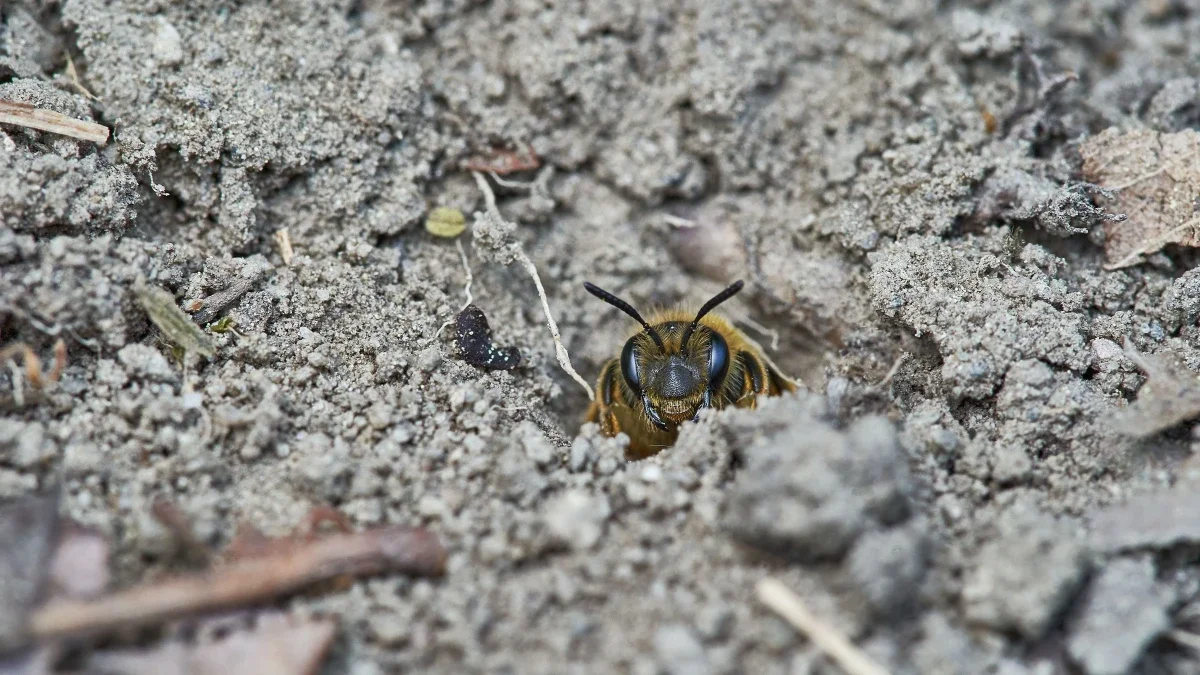
There's a patch in the back corner of the yard that always mows a little rough — a low spot near the fence line where the grass thins out over bare dirt. You've run the mower over it a hundred times. Then one afternoon in August the ground seems to come apart: a fast, angry stream of wasps pouring straight up out of a hole you never even noticed was there.
Here's the honest version the "just spray the hole" videos skip. The nest under the porch eave is the one you can size up before you ever touch it. The one living in an old chipmunk burrow is the one that lands people in the emergency room — because the whole colony, sometimes many thousands of wasps, sits underground where your mower's vibration reaches it a full second before you see a single insect. You can't see how big it is, and by late summer it is both the largest and the touchiest it will be all year.
What a ground nest actually is (and why the entrance fools you)
WHAT: A ground-nesting yellowjacket colony is usually a repurposed hole. The University of California's IPM program notes that "Yellowjackets commonly build nests in rodent burrows, but they sometimes select other protected cavities, such as voids in walls and ceilings of houses, as nesting sites" (UC Statewide IPM Program). University of Maryland Extension says the same in plainer terms: some yellowjackets "nest in the ground (such as in an old rodent or rabbit burrow)" (University of Maryland Extension).
The paper nest itself — the tiered gray comb wrapped in a papery envelope — is built down inside that cavity, out of sight. What's left at the surface is a single small opening, often no wider than a quarter and sometimes half-hidden under grass, a rock, or the lip of a landscape timber. That's the whole problem: the visible part is tiny and the dangerous part is buried. You aren't looking at the nest. You're looking at a doorway.
Why late summer turns a quiet hole into a hazard

WHY: A colony starts in spring as a single queen and grows all season. UC IPM notes colonies "can reach populations of between 1,500 and 15,000 individuals, depending on the species." University of Maryland Extension describes the same arc: "The nest population gradually increases until it reaches its largest number of wasps by late summer or early autumn."
Two things stack up at exactly the wrong time. The colony is at peak headcount, and natural food is running short, which shortens tempers. As UC IPM puts it, "Defensive behavior increases as the season progresses and colony populations become larger while food becomes scarcer." So the same hole you mowed past safely in June can hide thousands of primed defenders by Labor Day. Nothing about the entrance changes — the risk behind it does.
The real trigger is vibration, not just a footstep
HOW it goes wrong: People assume you have to step on the hole. You don't. University of Maryland Extension is specific: "Vibrations near a nest, such as from a lawn mower or electric hedge clippers, can trigger a defensive response." A mower pushes vibration through the soil several feet out in every direction. The colony reads that as an attack on the nest and answers before you're anywhere near the opening — which is why so many ground-nest stings happen mid-chore, not while poking around.
And a yellowjacket is not a honey bee. A honey bee stings once and dies, because its barbed stinger tears loose. Yellowjackets are "capable of stinging repeatedly, unlike honey bees" (University of Maryland Extension). One disturbed colony can put dozens of stings on a single person in a matter of seconds, and that is what turns a ground nest from a nuisance into a genuine medical event.
How to find the nest before it finds you

HOW: The safest way to locate a ground nest is to watch, not poke. On a warm evening near dusk, stand well back — 15 feet or more — and look for a steady two-way stream of wasps flying in and out of one point in the ground. That traffic line is the tell: a single wasp cruising the yard means nothing, but a busy in-and-out column pinpoints the entrance. Do it at a distance, in still clothing, staying downwind if you can. Do not walk the lawn probing for holes, and never pour anything down an opening you found by stumbling onto it.
Once you've marked the spot from a safe distance, it helps to see how a buried nest differs from the exposed nests most people picture:
| Underground yellowjacket nest | Aerial nest (eave, shrub, tree) | |
|---|---|---|
| What you see | One small hole in the dirt; the nest is hidden below | The whole paper nest, envelope and all |
| Judging its size | You can't — it's buried, and usually bigger than it looks | You can roughly eyeball how large it is |
| How people get stung | Mowing, trimming, or foot traffic sending vibration | Reaching into or bumping the nest directly |
| If it's disturbed | Wasps rise from the ground around your feet | Usually one direction to back steadily away from |
Treating it yourself — and the honest case for a pro
HOW (if you insist): Timing is everything. Wasps are inside the nest and least active in the dark, so any treatment happens at night or the very edge of dusk — not at noon, when foragers are out and the colony is hottest. But do not read "at night" as "safe." UC IPM is blunt: "Wasps are most likely to be in the nest at night, but even after dark and using formulations that shoot an insecticide stream up to 20 feet, stinging incidents are likely." Cover exposed skin, keep a clear escape path behind you, treat the entrance with a product labeled for the job, and leave immediately — don't stand and watch your work.
LIMIT: The buried colony is exactly what punishes overconfidence. You can't see how many wasps are down there, or whether the cavity has a second exit behind you. That uncertainty is why both UC IPM ("Hiring a pest control professional will reduce risks to you and your family") and University of Maryland Extension ("Hire a pest control professional if you do not feel comfortable treating a nest yourself") point the same way. If the hole is near a doorway, a walking path, kids or pets — or if anyone in the household is sting-allergic — the professional is the cheap option, not the fancy one. For where that line sits in general, our safe nest-removal walkthrough and the broader DIY pest control guide lay it out. A ground nest lands on the "hand it off" side far more often than an exposed one — and a soda-bottle trap only thins out foragers cruising the yard; it does nothing to the colony sitting underground.
When a sting becomes an emergency (this isn't medical advice)

For a normal single sting, MedlinePlus describes ordinary first aid: clean the area thoroughly with soap and water, then ice it "for 10 minutes and then off for 10 minutes." Pain, redness, and swelling right at the sting site are expected and usually fade on their own.
A whole-body reaction is a different animal, and it can move fast. Warning signs worth taking seriously include "Swelling of throat, lips, tongue, and mouth," "Difficulty breathing," hives spreading well beyond the sting, a racing heart, or dizziness. MedlinePlus is direct about the response: "Call 911 or the local emergency number if the person has an allergic reaction (severe swelling or difficulty breathing)" (MedlinePlus). If someone already knows they're allergic, the guidance is to "always carry a bee sting kit and know how to use it" — those kits "contain a medicine called epinephrine, which you should take right away if you get a wasp sting," used exactly as their own doctor prescribed. This isn't medical advice: when a reaction spreads past the sting site, get professional help immediately instead of waiting to see how it plays out. Someone hit with many stings at once, or stung inside the mouth or throat, also warrants a call to a doctor or poison control even without a known allergy.
The honest bottom line
The yellowjacket nest you should worry about most is the one you can't see. An old rodent burrow in the lawn hides a colony that's biggest and most defensive in late summer, and a mower's vibration alone is enough to set it off before you spot a single wasp — each of which can sting again and again. Find it by watching the flight line at dusk from a safe distance, not by probing the grass. If you treat it, do it after dark, covered, with a clear exit, and with no illusion that darkness makes it safe. And when the nest is in a bad spot or anyone nearby is allergic, calling a professional isn't giving up — it's the read the extension experts themselves recommend. The stakes here are your airway, not your pride.






0comments